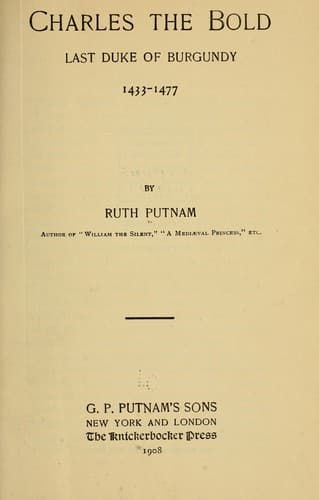
Charles the Bold, Last Duke of Burgundy, 1433-1477Putnam, Ruth
History
Charles the Bold, Last Duke of Burgundy, 1433-1477
Putnam, Ruth
Burgundy (France) -- History; Charles, Duke of Burgundy, 1433-1477; Switzerland -- History -- 1032-1499
Potent arguments like these induced Matthias not only to turn his back
on Podiebrad, but to accept that deposed monarch's crown which the
Bohemian nobles offered him May 3, 1469. Then he proceeded to ally
himself with Frederic, elector palatine, and with the elector of
Bavaria. This was the moment when the ex-king of Bohemia made renewed
offers of friendly alliance to Charles of Burgundy. In his name the
Sire de Stein brought the draft of a treaty of amity to Charles which
contained the provision that Podiebrad should support the election
of Charles as King of the Romans, in consideration of the sum of two
hundred thousand florins (Rhenish).[2]
This modest sum was to secure not only Podiebrad's own vote but his
"influence" with the Archbishop of Mayence, the Elector of Saxony
and the Margrave of Brandenburg.[4] While Podiebrad thus dangled
the ultimate hopes of the imperial crown before the duke's eyes, he
over-estimated his credulity. As a matter of fact the royal exile had
no "influence" at all with the first named elector, and the last, too,
showed no disposition whatsoever to serve his unstable policy. Both
were content to advise Emperor Frederic. The sole result of the empty
overtures was to increase Charles's own sense of importance.
Another negotiation which sought him unasked had, however, a material
influence on the course of events, and must be touched on in some
detail. Sigismund of Austria--first duke then archduke,--Count of
Tyrol, cousin of the Emperor Frederic, was a member of the House of
Habsburg. In 1449, he had married Eleanor of Scotland, and became
brother-in-law of Louis during the term of the dauphin's first
marriage. An indolent, extravagant prince, he was greatly dominated
by his courtiers. His heritage as Count of Tyrol included certain
territories lying far from his capital, Innsbruck. Certain portions
of Upper Alsace, lands on both sides of the Rhine, Thurgau, Argau in
Switzerland, Breisgau, and some other seigniories in the Black Forest
were under his sway.
These particular domains were so remote from Innsbruck that the
authority of the hereditary overlord had long been eluded. The nobles
pillaged the land near their castles very much at their own sweet
will. The harassed burghers appealed to the Alsatian Décapole,[5] and
again to the free Swiss cantons for protection, and sometimes obtained
more than they wanted.
Public-domain text, read in full here on John Shaqi.
Reviews
Reviews
No reviews yet
Be the first to share your thoughts on this work.
Elsewhere in the archive
Join the Discussion
Join the discussion
Sign in to leave a comment or review.
Sign InorCreate an account