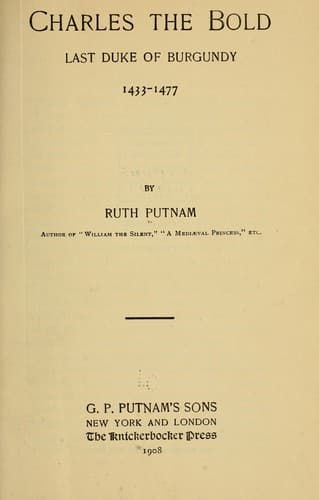
Charles the Bold, Last Duke of Burgundy, 1433-1477Putnam, Ruth
History
Charles the Bold, Last Duke of Burgundy, 1433-1477
Putnam, Ruth
Burgundy (France) -- History; Charles, Duke of Burgundy, 1433-1477; Switzerland -- History -- 1032-1499
The third commission (1473) was under the auspices of Monseigneur
Coutault, master of accounts at Dijon. He carried with him the report
of his predecessors and made his additions thereto.
Charles's directions to Poinsot and Pellet (June 13, 1471) were vague
and general. They were "to see the conduct of his affairs" _(voir la
conduite de ses affaires_). The important point was to find out how
much revenue could be obtained. As the duke's plan of expansion grew
larger he had need of all his resources.
The reports were eminently discouraging. Outlay was needed
everywhere--income was small. As the chances of peculation diminished,
the castellans deserted their posts and left the castles to decay.
The Burgundian commission of 1471 found the difficulties of their
exploration increased by two items. Charles had not advanced an
allowance for their expenses and they were anxious to be back at
Vesoul by Michaelmas, the date of the change in municipal offices and
of appropriations for the year. It was in hopes of receiving advance
moneys that they delayed in starting, but the approaching election and
coming winter finally decided them to set out, pay their own expenses,
and complete the business as rapidly as they could in a fortnight.
The summary of this report of 1471 was that there was little present
prospect that Charles would be able to reimburse himself for his
necessary expenses. An undue portion of authority and of revenue was
legally lodged in alien hands. Charles was possessed of germs of
rights rather than of actual rights. The earlier creditors of Austria
held all the best mortgages with their attendant emoluments. The
immediate profits accruing to the Duke of Burgundy fell far short
of the minimum necessary to disburse to keep his government, his
strongholds, his highways in repair. Very disturbed were the good
treasurer of Vesoul and the procureur-general of Amont at this state
of affairs, and distressed at the prospect of the ampler receipts from
Burgundy being required to relieve the pressing necessities of the
poor territories _de par de là_.
To avoid this contingency, the commissioners recommended the duke
to redeem all the existing mortgages great and small. It would cost
140,000 florins, but the revenue would at once increase with the new
security which would immediately follow under firm Burgundian rule.
Sole master, Charles could then enforce obedience from nobles and
cities and better conditions would be inaugurated.
Evidently this rational advice was not taken, for it is repeated by
Coutault in 1473. Redemption of the mortgages, "if your affairs can
afford it," is the counsel given by the chamber of accounts at Dijon,
though this sage board adds that they were well aware that in the
previous month Monseigneur could not put his hands on a hundred
florins to redeem one wretched little _gagerie._ The native coffers of
the region did not suffice to settle the salaries of the officers in
charge.
Public-domain text, read in full here on John Shaqi.
Reviews
Reviews
No reviews yet
Be the first to share your thoughts on this work.
Elsewhere in the archive
Join the Discussion
Join the discussion
Sign in to leave a comment or review.
Sign InorCreate an account