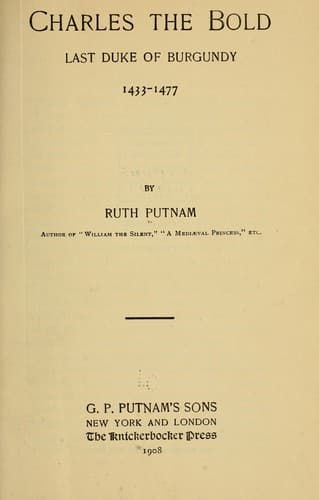
Charles the Bold, Last Duke of Burgundy, 1433-1477Putnam, Ruth
History
Charles the Bold, Last Duke of Burgundy, 1433-1477
Putnam, Ruth
Burgundy (France) -- History; Charles, Duke of Burgundy, 1433-1477; Switzerland -- History -- 1032-1499
In his assumption of this involved and doubtful property, Charles laid
heavy responsibilities on his shoulders. The actual price of fifty
thousand gold florins paid to Sigismund was a mere fraction of the
pecuniary obligations incurred, while the weight of care was difficult
to gauge. He succeeded to princes weak, frivolous, prodigal, whose
misrule had long been a curse to the land. The incursions of
the Swiss, the repeated descents of the Rhine nobles from their
crag-lodged strongholds to pillage and destroy, terrified merchants
and plunged peaceful labourers into misery.
Through hatred of the absentee Austrians, the neighbouring cities
repeatedly became the accomplices of these brigands, affording them
asylums for refitting and free passage when they were laden with
evident booty.
In all departments of finance and administration disorder prevailed.
The chief officials, castellans and councillors, enjoyed high salaries
for neglected duties. The castles were in wretched repair and there
were insufficient troops to guard the roads. There was no dependence
upon the receipts nominally to be expected. In the sub-mortgaged
lands, the lords simply levied what they could, without the slightest
responsibility for the order of the domain; they did not hesitate to
charge their suzerain for repairs never made, confident that no one
would verify their declaration.
In the territories of the immediate domain, the Austrian dukes and
their officials had no notion of the rigid system maintained in
Burgundy. Only here and there can little memoranda be found and these
are confused and obscure. There is a dearth of accurate records like
those voluminous registers of outlays kept by Burgundian receivers,
registers so rich in detail that they are more valuable for the
historian than any chronicle.
Exact appraisal of the resources of these _pays de par de là_ was very
difficult. Between 1469 and 1473 there were three efforts to obtain
reliable information by means of as many successive commissions
despatched to the Rhine valley by the Duke of Burgundy.
Envoys drew up minutes of their observations in addition to their
official reports and all were preserved in the archives. As these were
written from testimony gathered on the spot, such as the accounts of
the receivers now lost, etc., there is real value in the documents.
The first commission in behalf of Burgundy was composed of two Germans
and three Walloons. One of the former was Peter von Hagenbach, who
won no enviable reputation in the later exercise of his office as
lieutenant-governor of the annexed region, to which he was shortly
afterwards appointed. This first commission entered into formal
possession in Charles's name and instituted some desired reforms
immediately, such as policing the highways, etc.
The second commission made its visit in 1471. It consisted of Jean
Pellet, treasurer of Vesoul, and Jean Poinsot, procureur-general of
Amont.
Public-domain text, read in full here on John Shaqi.
Reviews
Reviews
No reviews yet
Be the first to share your thoughts on this work.
Elsewhere in the archive
Join the Discussion
Join the discussion
Sign in to leave a comment or review.
Sign InorCreate an account