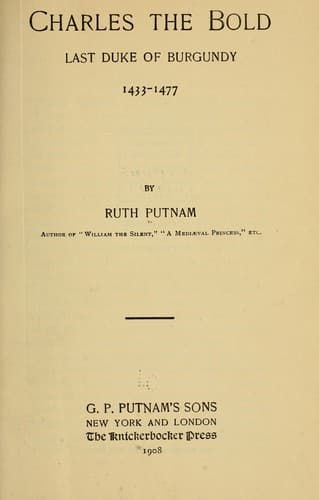
Charles the Bold, Last Duke of Burgundy, 1433-1477Putnam, Ruth
History
Charles the Bold, Last Duke of Burgundy, 1433-1477
Putnam, Ruth
Burgundy (France) -- History; Charles, Duke of Burgundy, 1433-1477; Switzerland -- History -- 1032-1499
In order to follow out the extension of Burgundian jurisdiction in
one direction, the course of events in the duke's life has been
anticipated a little. The thread of the story now returns to 1469,
when Charles and Sigismund separated at St. Omer both well pleased
with their bargain. Charles tarried for a time at Ghent and Bruges
and then proceeded to Zealand and Holland, where his sojourn had been
interrupted in 1468 by his alarm about French duplicity. In the glow
caused by his past achievements, his present reputation, and future
prospects, Charles of Burgundy was in a mood to prove to his subjects
his excellence as a paternal ruler. Wherever he paused on his journey
easy access was permitted to his presence and he was lavish in the
time given to receiving petitions from the humblest plaintiff. The
following gruesome incident is an illustration of the summary methods
attributed to him.[1]
Shortly before the ducal visit to Middelburg, the governor, a man
of noble birth, a knight, fell in love with a married woman who
indignantly repudiated his advances. In revenge the governor had the
husband arrested on a charge of high treason. The wife, left without a
protector, continued obdurate to the knight until the alternative of
her husband's release or his death was offered her as the reward for
accepting the governor's base suit or as the penalty of her refusal.
She chose to redeem the prisoner. Having paid the price she went to
the prison and was led to her husband truly, but he lay dead and in
his coffin!
When the Duke of Burgundy was once within the Zealand capital, this
injured woman hastened to throw herself at his feet, a petitioner
for justice. He heard her complaint and straightway summoned the
ex-governor to his presence. The accused confessed that he had been
carried away by his adoration for the woman, reminded Charles of
his long and faithful devotion to the late duke and to himself, and
offered any possible reparation for his crime. The duke ordered him to
marry his victim. The widow was horrified at the suggestion, but was
forced by her family to accept it. After the nuptial benediction, the
knight again appeared before Charles to assure him that the plaintiff
was satisfied. "She, yes," replied the duke coldly, "but not I." He
remanded the bridegroom to prison, had him shriven and executed all
within an hour. Then the bride was summoned and shown her second
husband in his coffin as she had seen her first, and on the same spot.
"It was a penalty that hit the innocent as well as the guilty, for the
plaintiff died from the double shock."
Public-domain text, read in full here on John Shaqi.
Reviews
Reviews
No reviews yet
Be the first to share your thoughts on this work.
Elsewhere in the archive
Join the Discussion
Join the discussion
Sign in to leave a comment or review.
Sign InorCreate an account