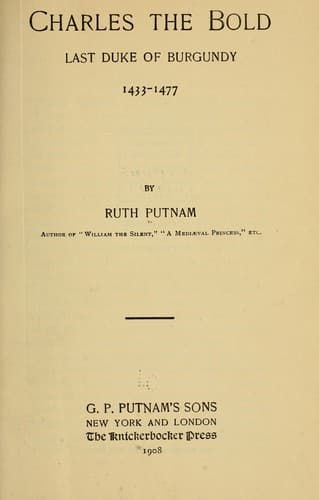
Charles the Bold, Last Duke of Burgundy, 1433-1477Putnam, Ruth
History
Charles the Bold, Last Duke of Burgundy, 1433-1477
Putnam, Ruth
Burgundy (France) -- History; Charles, Duke of Burgundy, 1433-1477; Switzerland -- History -- 1032-1499
The duke, satisfied with his rigour, went on to Holland. Everywhere he
evinced himself equally uncompromising towards the nobles, amiable and
considerate towards the lower classes and humble folk. Various other
stories related about him at this epoch are difficult to accept as
authentic, for the main detail has appeared at other times under
different guises. Wandering tales seem to alight, like birds of
passage, on successive people in lands and epochs widely apart, mere
hallmarks of certain characteristics re-embodied.
The Hague was the duke's headquarters during two months, and there
also he held open court and gave audience to many embassies in the
midst of his administrative work pertaining to Holland and its nearest
neighbours. He took measures to recover what he claimed had been
usurped by Utrecht, and he initiated proceedings to make good the
title of Lord of Friesland, that will-o'-the wisp to successive Counts
of Holland and never acknowledged by the Frisians. In efforts to weld
together the various provinces the months passed, until a new turn of
foreign events began to absorb the duke's whole attention.
The details of English politics with all the reasons for revolution
and counter-revolution involved in the complicated civil disorders,
the Wars of the Roses, affected Charles's policy but they can only
be suggested in his biography. It must be remembered that the modern
impression of English stability and French fickleness in political
institutions, an impression casting reflections direct and indirect
upon literature as well as history, is based on the changes in France
from 1789 down to the fourth quarter of the nineteenth century. Quite
the reverse is the earlier tradition based on the kaleidoscopic
shifts familiar to several generations of observers in the fifteenth
century[2]; stable and firm felt the French as they heard the tidings
of the brief triumphs of belligerent factions across the Channel.
Since 1461, Henry VI. of the House of Lancaster had been a passive
prisoner, while Margaret of Anjou had exhausted herself in efforts
to win adherents at home and abroad for her captive husband and her
exiled son.[3] In 1463, she had received some aid, some encouragement
from Philip of Burgundy, although he had recognised Edward IV. as king
and although, too, his personal sympathies were Yorkish rather than
Lancastrian.
It was Charles who escorted the errant lady into Lille, but later the
duke himself entertained her munificently. The poverty-stricken exile
probably found the accompanying ducal gifts more to the immediate
purpose than the ducal feasts. Two thousand gold crowns were bestowed
upon herself, a hundred upon each of her ladies, while various
Lancastrian nobles were tided over hard times by useful sums of money.
Public-domain text, read in full here on John Shaqi.
Reviews
Reviews
No reviews yet
Be the first to share your thoughts on this work.
Elsewhere in the archive
Join the Discussion
Join the discussion
Sign in to leave a comment or review.
Sign InorCreate an account