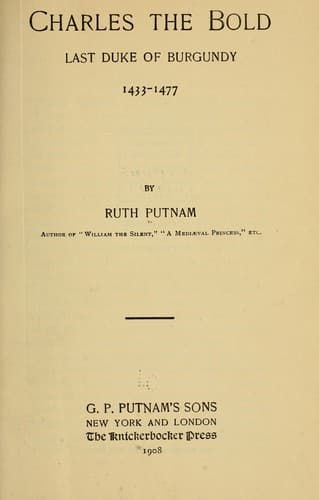
Charles the Bold, Last Duke of Burgundy, 1433-1477Putnam, Ruth
History
Charles the Bold, Last Duke of Burgundy, 1433-1477
Putnam, Ruth
Burgundy (France) -- History; Charles, Duke of Burgundy, 1433-1477; Switzerland -- History -- 1032-1499
Pleasant though the recognition was, however, the pecuniary assistance
was quite insufficient to accomplish Margaret's purpose. For nine
years Edward IV. sat on his throne and no serious efforts were made to
dislodge him. As he never forgot his mother's lineage, the sympathies
of Charles of Burgundy were with the exiles, and Queen Margaret may
have counted confidently on that sympathy proving valuable for her son
as soon as Charles himself had a free hand. But when he came into his
heritage, his marriage with Margaret of York put a definite end to
those hopes. The new duke thereby declared his acceptance of the king
whom the Earl of Warwick had seated upon the English throne. Then
came clashing of wills between that king and his too powerful
subject-adviser.[4] To punish his unruly royal protégé, Warwick turned
his attention to the Duke of Clarence, brother and heir presumptive to
Edward IV. A marriage was planned between this possible future monarch
and the earl's eldest daughter and then quickly celebrated at Calais
without the king's knowledge (July, 1469).
In the same summer occurred a rising in Yorkshire, possibly instigated
by Warwick.[5] The malcontents, sixty thousand strong, declared that
the king was giving ear to base counsellors and must be coerced into
better ways. An attempt to suppress this revolt by the royal troops
resulted in a pitched battle where Earl Rivers, the father of
Elizabeth Woodville, the young queen, was taken prisoner and beheaded.
Edward, baffled, finally turned for aid to Warwick. Over the Channel
hastened the earl and his new son-in-law, levied troops, met the king
at Olney, and--Edward found himself if not exactly a prisoner, at
least under restraint. Two sovereigns--both without power even over
their own actions,--such was the situation in England at the end of
1469, when Charles of Burgundy was self-complacently regarding Louis
XI. as a foe convinced of his own inferiority.
A menacing letter from this redoubtable ducal brother-in-law was
probably the reason why Edward IV. was set at liberty, and why a
reconciliation was patched up between him and his councillor, with
full pardon for Warwick's adherents. But it was short-lived. A fresh
outbreak in March, 1470, made another change. Warwick and Clarence
sided with the rebels, the king was victorious, and his unfaithful
friend and brother were again forced to flee under a shower of menaces
hurled after them.
"But, and He [Clarence] or Richart Erle of Warrewyk our Rebell and
Traytour come into oure seid Land we woll ... that ye doo Hym
and Theym to be arrested ... He that Taketh and Bryngeth unto Us
either of theym, he shal have for his Reward C._l_ of Land in
Yerely Value to Hym and to his Heyres or Mil. _Lib_ in Redy money
at his election."[6]
Such was the proclamation issued on March 22d by the king himself at
York.
Public-domain text, read in full here on John Shaqi.
Reviews
Reviews
No reviews yet
Be the first to share your thoughts on this work.
Elsewhere in the archive
Join the Discussion
Join the discussion
Sign in to leave a comment or review.
Sign InorCreate an account