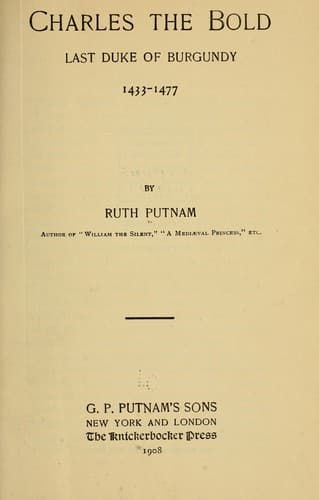
Charles the Bold, Last Duke of Burgundy, 1433-1477Putnam, Ruth
History
Charles the Bold, Last Duke of Burgundy, 1433-1477
Putnam, Ruth
Burgundy (France) -- History; Charles, Duke of Burgundy, 1433-1477; Switzerland -- History -- 1032-1499
"The vessels which you assure me are destined by the king for
an attack on England have attempted nothing except against my
subjects; but, by St. George, if some redress be not seen to, I
will take the matter into my own hands without waiting for your
motions, tardy and dilatory as they are."[16]
Reprisals were made accordingly, and the innocent French merchants,
coming peaceably to the fair at Antwerp, suffered confiscation of
their private property, while the duke felt fully justified in
stationing his fleet off the coast of Normandy to guard the Channel.
Philip de Commines was one of the company who went at the duke's
behest to Calais to urge the governor, Wenlock, to be faithful to King
Edward, and to give no shelter to the rebellious earl and his protégé
Clarence.[17]
Louis feared an outbreak of hostilities at an inconvenient moment. He
temporised. To Warwick, he denied a personal interview, but at the
same time he sent him a confidential emissary, Sr. du Plessis, to whom
he wrote as follows:
"Monsieur du Plessis, you know the desire I have for Warwick's
return to England, as well because I wish to see him get the
better of his enemies--or that at least through him the realm of
England may be embroiled--as to avoid the questions which have
arisen out of his sojourn here.... For you know that these Bretons
and Burgundians have no other aim than to find a pretext for
rupturing peace and reopening the war, which I do not wish to see
commenced under this colour.... Wherefore I pray you take pains,
you and others there, to induce Mons. de Warwick to depart by all
arguments possible. Pray use the sweetest methods that you can, so
that he shall not suspect that we are thinking of anything else
but his personal advantage."[18]
To gain time was Louis's ardent wish at that moment. The envoys
sent by Louis to placate the duke's resentment at the incidents in
connection with the Warwick affair, and to assure him that Louis meant
well by him and his subjects, found Charles holding high state at St.
Omer. When they were admitted to audience, the duke was discovered
sitting on a lofty throne, five feet above floor level, "higher than
was the wont of king or emperor to sit." His hat remained on his head
as the representatives of his feudal overlord bowed to him and he
acknowledged their obeisance by a slight nod and a gesture permitting
them to rise.
Public-domain text, read in full here on John Shaqi.
Reviews
Reviews
No reviews yet
Be the first to share your thoughts on this work.
Elsewhere in the archive
Join the Discussion
Join the discussion
Sign in to leave a comment or review.
Sign InorCreate an account