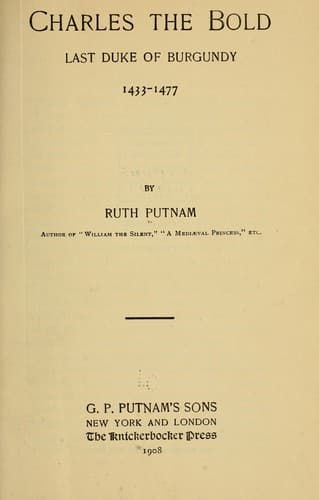
Charles the Bold, Last Duke of Burgundy, 1433-1477Putnam, Ruth
History
Charles the Bold, Last Duke of Burgundy, 1433-1477
Putnam, Ruth
Burgundy (France) -- History; Charles, Duke of Burgundy, 1433-1477; Switzerland -- History -- 1032-1499
Hugonet, a member of the ducal council, answered their address with
a prosy speech. Burgundian officials revelled in grandiloquent
phrases--which this time bored Charles, He cut short the harangue
impatiently, took the floor himself, and made a statement of the
injuries he had suffered. Louis had promised to be his friend, but he
was aiding the foe of the duke's brother. The envoys repeated their
sovereign's offers of redress. Charles declared that redress was
impossible. Pained, very pained were the French envoys to think that
a petty dispute could not be settled amicably. "The king desires to
avoid friction. He offers you friendship, peace, and redress for every
wrong. It will not be his fault if trouble ensue. Monseigneur, the
king and you have a judge who is above you both."
The insinuation that it was he who was ready to break the peace
infuriated Charles. He started to his feet, his eyes flashing with
fire. "Among us Portuguese there is a custom that when our friends
become friends to our foes we send them to the hundred thousand devils
of hell."[19] "A piece of bad taste to send by implication a king of
France to a hundred thousand devils," comments the suave Chastellain,
aghast at this impolite, emphatic, though indirect reference to Louis
XI.
Equally aghast were the Burgundian courtiers present at this occasion.
After all, they, too, were French by nature. To wreck the new-made
peace for the sake of the English alliance, which had never been
really popular among them, that seemed an act of rash unwisdom.
"A murmur went the rounds of the ducal suite because their chief
thus implied contempt for the name of France to which the duke
belonged. Not going quite so far as to call himself English,
though that was what his heart was, he boasted of his mother,
ancient friend of England and enemy of France."
There were, indeed, times when the duke was more emphatic in asserting
his English blood. Plancher cites a scrap of writing in his own hands
which probably belonged to a letter to the magistrates and citizens of
Calais, whom he addresses, "O you my friends."[20] While reiterating
that he simply must defend his own state he adds, "By St. George who
knows me to be a better Englishman and more anxious for the weal of
England than you other English ... [you] shall recognise that I am
sprung from the blood of Lancaster," etc. His claims of kinship varied
with the circumstances.
Public-domain text, read in full here on John Shaqi.
Reviews
Reviews
No reviews yet
Be the first to share your thoughts on this work.
Elsewhere in the archive
Join the Discussion
Join the discussion
Sign in to leave a comment or review.
Sign InorCreate an account