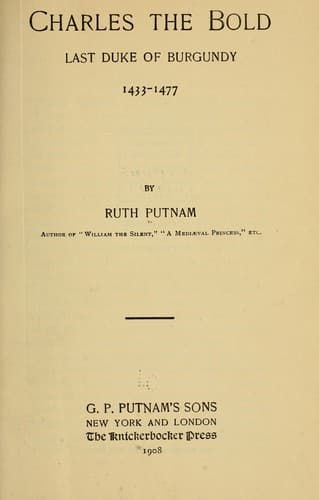
Charles the Bold, Last Duke of Burgundy, 1433-1477Putnam, Ruth
History
Charles the Bold, Last Duke of Burgundy, 1433-1477
Putnam, Ruth
Burgundy (France) -- History; Charles, Duke of Burgundy, 1433-1477; Switzerland -- History -- 1032-1499
While he was so conscious of his own greatness, present and future,
and of his own laudable intentions to do well by his subjects, it is
quite possible, too, that Charles was puzzled more or less consciously
by his failure to win popularity. For he was quite as unpopular with
his courtiers as with his subjects. The former did not like the rigid
court rules. There was no pleasure in sitting through audiences silent
and stiff "as at a sermon," and exposed to personal reprimands from
their chief if there were the slightest lapses from his standard of
conduct. They did not know on what meat the duke was feeding his
imagination, an imagination that already saw him as Cæsar. Had he
actually attained the loftier rank that he dreamed of, his premature
arrogance might have been forgotten, but his pride of glory invisible
to the world about him was undoubtedly a bar to his popularity during
the years 1470-73.
Before this pompous scene passed at St. Omer, Louis had been relieved
of anxiety in regard to the stability of his kingdom, and the dangers
of an heir like his brother who might easily be used as a tool by some
clever faction opposed to the ruling monarch. On June 10th, a son was
born to him, afterwards Charles VIII. of France. Complaisant still
were his words to his Burgundian cousin, but the moment was drawing
near when his efforts to circumvent him were no longer secret.
The embassy returned home. Possibly their report of the duke's
passionate words goaded the king into discarding his mask of
friendship. At any rate, his next steps were unequivocal in showing
which side of the fresh English quarrel he meant to espouse. Margaret
of Anjou hated the Earl of Warwick, not only because he had unseated
her husband but because he had doubted her fidelity to that husband.
Nevertheless, under Louis's persuasions, she consented to forget her
past wrongs and to stake her future hopes on fraternising with him on
a basis of common hate for Edward IV. The alliance was to be sealed
by the marriage of young Edward of Lancaster, the prince whose very
legitimacy Warwick had questioned, with the earl's younger daughter.
It was a singular union to be accepted by the parents, separated as
they had been by the wall of insults interchanged during more than a
decade of bitter enmity.
Louis brought his cousin to this step of concession. She saw her
seventeen-year-old son betrothed to the sixteen-year-old Anne Neville,
and later she herself swore reconciliation to Warwick on a piece of
the true cross in St. Mary's Church at Angers (August 4, 1470).
Public-domain text, read in full here on John Shaqi.
Reviews
Reviews
No reviews yet
Be the first to share your thoughts on this work.
Elsewhere in the archive
Join the Discussion
Join the discussion
Sign in to leave a comment or review.
Sign InorCreate an account