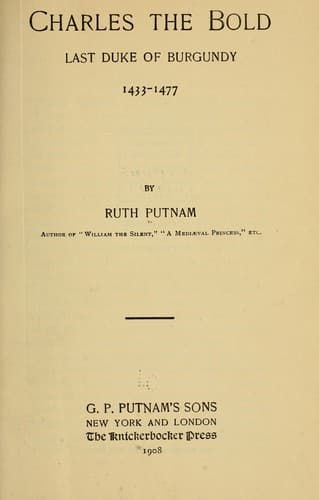
Charles the Bold, Last Duke of Burgundy, 1433-1477Putnam, Ruth
History
Charles the Bold, Last Duke of Burgundy, 1433-1477
Putnam, Ruth
Burgundy (France) -- History; Charles, Duke of Burgundy, 1433-1477; Switzerland -- History -- 1032-1499
[Footnote 14: The ancient quarrel between the old Holland parties of
Hooks and Cods continually blazed out anew. On one notable occasion,
to show her impartiality, the duchess appeared in public accompanied
by the stadtholder, Lelaing, a partisan of the Hooks, and by Frank van
Borselen, himself a Cod, the widower of Jacqueline, the late Countess
of Holland.]
[Footnote 15: Barante, _Histoire des Dues de Bourgogne_, vi., 2, note
by Reiffenberg.]
[Footnote 16: See _Catalogue des manuscrits des Ducs de Bourgogne,_
"Résumé historique," i., lxxix.]
[Footnote 17: Barante, vi., 2, note.]
[Footnote 18: Loomis, _Medieval Hellenism_.]
[Footnote 19: Pirenne, _Histoire de Belgique_, ii., 231.]
[Footnote 20: It was in June, 1434, that this alliance had been made.
Sigismund claimed that Philip had no right in Brabant, Holland,
Zealand, and Hainaut, which in his opinion were lapsed fiefs, of the
empire.]
[Footnote 21: Putnam, _A Medieval Princess_.
[Footnote 22: Monstrelet, _La Chronique_, v., 344.]
[Footnote 23: La Marche, _Mémoires_, ii., 50.]
[Footnote 24: Reiffenberg, _Essai sur les enfants naturels de Philippe
de Bourgogne._]
[Footnote 25: Meyer, _Commentarii sive Annales rerum Flandricarum, _
p. 296.]
CHAPTER II
YOUTH
1440-1453
The heir of Burgundy was still in very tender years when he began to
take official part in public affairs, sometimes associated with one
parent, sometimes with the other.
There was a practical advantage in bringing the boy to the fore by
which the duke was glad to profit. With his own manifold interests, it
was impossible for him to be present in his various capitals as often
as was demanded by the usage of the diverse individual seigniories. It
was politic, therefore, to magnify the representative capacity of his
son and of his consort in order to obtain the grants and _aides_ which
certain of his subjects declared could be given only when requested
orally by their sovereign lord. Thus, in 1444, it was Count Charles
and the duchess who appeared in Holland to ask an _aide_.[1] In the
following year, Charles accompanied his father when Philip made one
of his rare visits--there were only three between 1428 and 1466--to
Holland and Zealand.
[Illustration: A CASTLE IN BURGUNDY]
Public-domain text, read in full here on John Shaqi.
Reviews
Reviews
No reviews yet
Be the first to share your thoughts on this work.
Join the Discussion
Join the discussion
Sign in to leave a comment or review.
Sign InorCreate an account