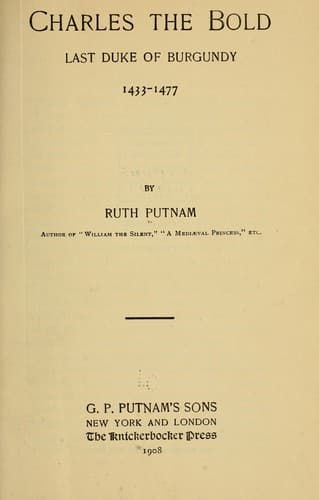
Charles the Bold, Last Duke of Burgundy, 1433-1477Putnam, Ruth
History
Charles the Bold, Last Duke of Burgundy, 1433-1477
Putnam, Ruth
Burgundy (France) -- History; Charles, Duke of Burgundy, 1433-1477; Switzerland -- History -- 1032-1499
"My cousin, since it is the pleasure of my very redoubtable seigneur
and father, I promise you that, you being alive, I will take none
other than you and I promise to take you when God permits it." So
wrote Mary with her own hand on June 13, 1472, at Mons. On December
3d, she declared all such pledges revoked as though they never had
been made, and Nicholas, too, formally renounced his pretensions to
her hand.
There were several moments when Charles of France had appeared to be
very near acceptance as Mary's husband, and several other princes
seemed eligible suitors. Doubtless her father found his daughter very
valuable as a means of attracting friendship. Doubtless, too, as
Commines says, he was not anxious to introduce any son-in-law into his
family. His fortieth year was only completed in 1473, and he was by no
means ready to range himself as an ancestor.
At successive times the negotiations between Charles and Frederic were
ruptured only to be renewed on some slightly different basis. Threaded
together they made a story fraught with interest for Louis XI., and
one that, very probably, he had an opportunity to hear. Up to August,
1472, it is a safe inference that Philip de Commines was fully
cognisant of the propositions and counter-propositions, the
understandings and misunderstandings, the private letters of, as well
as the interviews with, the accredited Austrian envoys that appeared
at one Burgundian camp after another. Probably there was nothing more]
valuable in the store of learning carried by the astute historian from
his first patron to his second than all this fund of confidential
miscellany.
It seems a fair surmise that Louis XI. enjoyed immensely the
delightful private view into his rival's dreams, the disappointments
and rehabilitation of his shattered visions. The relation would have
made him not only fully aware of the reasons why Charles was diverted
from his hot pursuit of the Somme towns, but thoroughly informed as to
the great obstacles lying in the path which the duke hoped to travel.
Naturally, the king was quite willing to rest assured that ruin was
inevitable. If his rival were disposed to wreck himself rashly on
German shoals, the king was equally disposed to be an acquiescent
onlooker and to spare his own powder.
Public-domain text, read in full here on John Shaqi.
Reviews
Reviews
No reviews yet
Be the first to share your thoughts on this work.
Elsewhere in the archive
Join the Discussion
Join the discussion
Sign in to leave a comment or review.
Sign InorCreate an account