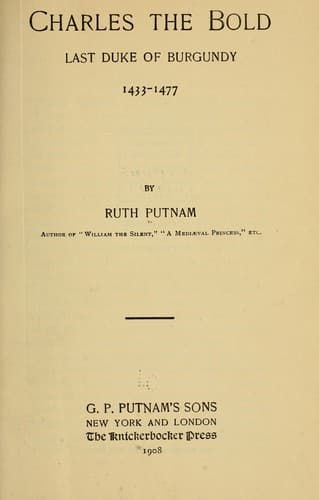
Charles the Bold, Last Duke of Burgundy, 1433-1477Putnam, Ruth
History
Charles the Bold, Last Duke of Burgundy, 1433-1477
Putnam, Ruth
Burgundy (France) -- History; Charles, Duke of Burgundy, 1433-1477; Switzerland -- History -- 1032-1499
On his part, Charles was wholly unconscious of the extent of his loss
of prestige within the French realm in 1472. There had been other
periods when the king had appeared triumphant over his aspiring nobles
only to be again checked by their alliance. In the radical change
undergone by the feudatories after Guienne's death and Brittany's
reconciliation, there was, however, no opening left for the Duke
of Burgundy's re-entry as a French political leader. It was this
definitive cessation of his importance that Charles failed to
recognise. Confident that his star was rising in the east he did
not note the significance of its setting in the west. Thereupon the
situation was,--Charles, believing that his plans were his own
secret, _versus_ Louis, fully advised of those plans and alert to all
incidents of the past, present, and future in a fashion impossible to
the duke in his absorbed contemplation of his own prospects, blocking
the scope of his view.
With the emperor's congratulations at the duke's accession to
Guelders, and his offers to invest him with the title, were coupled
intimations that it was an opportune moment to resume consideration of
an alliance between the Archduke Maximilian and Mary of Burgundy. The
duke accepted the new overtures, and Rudolf de Soulz and Peter
von Hagenbach proceeded to the Burgundian and Austrian courts
respectively, as confidential envoys to discuss the marriage.[10]
Charles was far more gracious to De Soulz than he had been to the
last imperial messenger, the Abbé de Casanova, who had restricted his
proposals to Mary's fortunes and ignored her father's. The duke had no
intention of permitting any conference to proceed on that line. He was
explicit as to his requisitions. De Soulz was surprised by a gift of
ten thousand florins, explained by the phrase, "because Monseigneur
recognised the love and affection borne him by the said count." That
was a simple retainer. Other benefits, offices, and estates were
conferred, to take effect on the day when Monseigneur was named King
of the Romans.
The instructions to Hagenbach were definite, covering the ground
of those previously mentioned, issued in 1470. He was, however,
especially enjoined to assure Frederic that the duke did not require
his abdication. He would be content to step into the shoes naturally
vacated by his death.
Public-domain text, read in full here on John Shaqi.
Reviews
Reviews
No reviews yet
Be the first to share your thoughts on this work.
Elsewhere in the archive
Join the Discussion
Join the discussion
Sign in to leave a comment or review.
Sign InorCreate an account