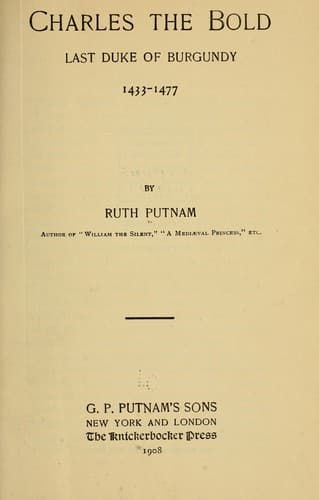
Charles the Bold, Last Duke of Burgundy, 1433-1477Putnam, Ruth
History
Charles the Bold, Last Duke of Burgundy, 1433-1477
Putnam, Ruth
Burgundy (France) -- History; Charles, Duke of Burgundy, 1433-1477; Switzerland -- History -- 1032-1499
"After this statement, which was marvellously honest, the emperor
arose from the throne, wine and spices were brought, and then
Monseigneur escorted the emperor to his quarters with grand
display of torches. This is the outline of what happened on
October 4th, in the said year lxxiii. And as to the future, next
Thursday the emperor will dine where Monseigneur lodges, _et là
fera les grants du roy_,[6] and there will be novelties. In regard
to the fashion of the said emperor and his estate, he is a very
fine prince and attractive, very robust, very human, and benign.
I do not know with whom to compare his figure better than
Monseigneur de Croy, as he was eight or ten years ago, except that
his flesh is whiter than that of the Sr. de Croy. The emperor has
seven or eight hundred horse as an escort, but the major part
of the nobles present come from this locality. In regard to
Monseigneur's departure, there is no news, and they make great
cheer--this is all for this time."
The German scholars in the imperial party listened most
attentively to the style of the Netherlander's speech as well as
to his subject-matter. "More abundant in vocabulary than elegant
in Latinity," was their comment, a fault they considered marking
all French Latin. The audience found time to note the style for
the subject of the address did not interest them greatly. The
least observant onlooker knew that the main purpose of this
interview was not the plan of a Turkish campaign, though Frederic
appointed a committee to discuss that, whose members, Burgundian
and German in equal numbers, were instructed to study the Eastern
question while emperor and duke were absorbed in other matters.[7]
In their very first session, this committee decided that the
chief obstacle to a Turkish expedition was the Franco-Burgundian
quarrel. This point was also raised by Charles in his first
conference with Frederic. No campaign was feasible until the
European powers were ready to act in concert. Louis XI. was aiding
and abetting the heathen by being a disturbing element which
rendered this desired unity impossible. So Frederic appointed a
fresh commission to discuss European peace. And this insolvable
problem was a convenient blind for other discussions.
On October 5th, a Burgundian fête gave new occasion for a display
of wealth; "vulgar ostentation," sneered the less opulent German
nobles who tried to show that their pride was not wounded by the
sharp contrasts between imperial habits and those of a mere duke.
On their side, the Burgundians remarked that it was a pity to
waste good things on boors so little accustomed to elegantly
equipped apartments that they used silken bedspreads to polish up
their boots!
Public-domain text, read in full here on John Shaqi.
Reviews
Reviews
No reviews yet
Be the first to share your thoughts on this work.
Elsewhere in the archive
Join the Discussion
Join the discussion
Sign in to leave a comment or review.
Sign InorCreate an account