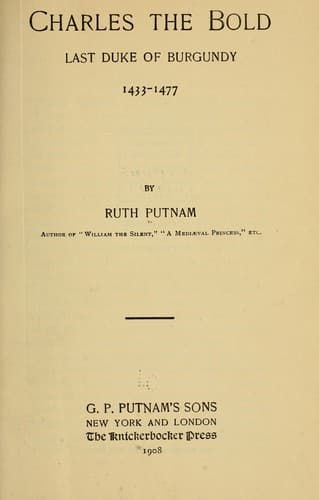
Charles the Bold, Last Duke of Burgundy, 1433-1477Putnam, Ruth
History
Charles the Bold, Last Duke of Burgundy, 1433-1477
Putnam, Ruth
Burgundy (France) -- History; Charles, Duke of Burgundy, 1433-1477; Switzerland -- History -- 1032-1499
A running commentary of international criticism, fine feasts,
ostensible negotiations about projects that probably no one
expected would come to pass, and an undercurrent, persistent
and mandatory, of demands emphatically made on one side, feebly
accepted by the other while the two principals were together, and
petulantly disliked by the emperor as soon as he was alone again
--such was the course of the conference.
Frederic III. had one simple desire--to marry his son to the
Burgundian heiress. Charles desired many things, some of which are
clear and others obscure. The very fact that the emperor did not
at once refuse his demands, gave him confidence that all were
obtainable. Very probably he hoped to overawe his feudal chief
by a display of his resources, and by showing the high esteem in
which he was held by all nations. There at Trèves, embassies came
to him from England, from various Italian and German states, and
from Hungary.
On October 15th, a treaty was signed that made the new Duke of
Lorraine virtually a vassal to Charles, an important step towards
Burgundian expansion. There was time and to spare for these many
comings and goings during the eight weeks of the sojourn at
Trèves, and the duke was not idle. That his own business hung
fire, he thought was due to the machinations of Louis XI. He had
no desire to prolong his visit, for he was well aware of the
risk involved in keeping his troops in Trèves.[8] At first the
magnificence of his equipage had amused the quiet old town, but
little by little, in spite of the duke's strict discipline, the
presence of idle soldiers became very onerous. Charles did not
hesitate to hang on the nearest tree a man caught in an illicit
act, but much lawlessness passed without his knowledge. Provisions
became very dear; there was some danger of an epidemic due to the
unsanitary conditions of the place, ill fitted to harbour so many
strangers. The precautions instituted by the Roman founders in
regard to their water supply had long since fallen into disuse.
Weary of delays, the duke demanded a definite answer from the
emperor as to the proposed kingdom, the matrimonial alliance, and
his own status. Frederic appeared about to acquiesce, and then
substituted vague promises for present assent to the demands. But
when Charles, indignant, broke off negotiations on October 31st,
and began to prepare for immediate departure, Frederic became
anxious, renewed his overtures, and a new conference took place,
in which he consented to fulfil the duke's wishes, with the
proviso the sanction of his election should be obtained.
Public-domain text, read in full here on John Shaqi.
Reviews
Reviews
No reviews yet
Be the first to share your thoughts on this work.
Elsewhere in the archive
Join the Discussion
Join the discussion
Sign in to leave a comment or review.
Sign InorCreate an account