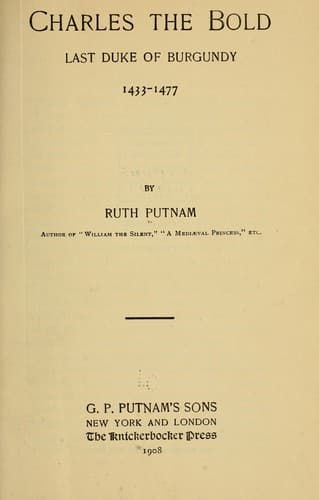
Charles the Bold, Last Duke of Burgundy, 1433-1477Putnam, Ruth
History
Charles the Bold, Last Duke of Burgundy, 1433-1477
Putnam, Ruth
Burgundy (France) -- History; Charles, Duke of Burgundy, 1433-1477; Switzerland -- History -- 1032-1499
"Know that our lord the emperor has made the Duke of Burgundy a
king of the lands hereafter mentioned and has assured the royal
title to him and his heirs, male and female; all the territories
that he holds from the empire together with Guelderland lately
conquered, and the land of Lorraine, lately lapsed to the empire
in fief, besides the duchy of Burgundy that formerly was held from
the crown of France; also the bishoprics of Liege, Utrecht, Dolen,
and others belonging to the empire, besides a few seigniories,
also imperial fiefs. All this, royalty and principalities, he
receives from a Roman emperor."
So wrote Albert of Brandenburg on November 13th, trusting to the
word of an envoy who had left matters in so advanced a state when he
departed from Trèves that he felt safe in concluding that achievement
had been reached.[12]
Various letters from the citizens of Berne, too, were filled with
rumours from Trèves. Most extraordinary is one of November 29th,
intended to go the rounds of the Swiss confederacy, containing _exact
details of the coronation of Charles as it had taken place five days
previously_. The boundaries of the new kingdom were specified.[13]
Venice, in hot haste to please the monarch, had instantly shown
exceptional honour to the Burgundian resident. How exact it all
sounded! Yet there was no truth in it.
The vacillating emperor was affected by the attitude of his suite, and
by their varying representations. There is no actual proof of French
interference, but French agents had been seen in the city, and might
have had private audiences with the emperor. Gradually, relations
changed between Charles and Frederic. There was a cloud, not
dissipated by a three days' fête given by the duke (November
19th-22d), evidently in farewell. Was Charles too exigeant with his
demands, too chary of his daughter? Probably.
On November 23d, instead of a definitive treaty a simple convention
was signed, postponing the coronation until February. Emperor and
regal candidate were to meet again at Besançon, Cologne, or Basel. In
the interval, Charles was to come to a satisfactory understanding with
the electors and obtain their official endorsement for the imperial
grant.
November 25th was appointed, _not_ for the regal investiture, but for
Frederic's departure. On the evening of the 24th, he gave audience to
his councillors and princes. The electors present were urged by the
Burgundians to give their own conditional approval at least, and to
consent to a reduction of the military obligations to be incurred
by Charles. It was a crisis, however, where nobody wished to pledge
anything definitely. There was an evident disposition to await some
further issue before final action.
Public-domain text, read in full here on John Shaqi.
Reviews
Reviews
No reviews yet
Be the first to share your thoughts on this work.
Elsewhere in the archive
Join the Discussion
Join the discussion
Sign in to leave a comment or review.
Sign InorCreate an account