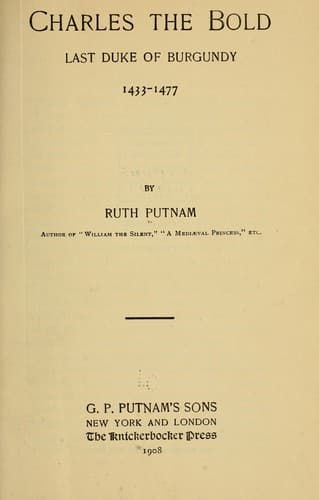
Charles the Bold, Last Duke of Burgundy, 1433-1477Putnam, Ruth
History
Charles the Bold, Last Duke of Burgundy, 1433-1477
Putnam, Ruth
Burgundy (France) -- History; Charles, Duke of Burgundy, 1433-1477; Switzerland -- History -- 1032-1499
Very imposing was the ceremony enacted in the market-place.
Frederic was exalted upon a high platform ascended by a flight
of steps. Charles, clad in complete steel but bareheaded and
unattended, rode slowly around the platform three times, "which
they say was the custom in such solemnities of investiture," adds
an eyewitness,[10] as though he considered the ceremony somewhat
archaic. Then the candidate dismounted, received the mantle of the
empire from an attendant, and slowly ascended the steps to the
emperor's feet, while a new escutcheon, displaying the insignia of
the freshly acquired fiefs, quartered on the Burgundian arms, was
carried before him. Kneeling at the emperor's feet, the duke laid
two fingers on his sword hilt and repeated the oath of fealty and
service in low but distinct tones. Other rites followed, and then
Charles was proclaimed Duke of Guelders.
[Illustration: MAXIMILIAN OF AUSTRIA, MEDAL]
Thus one object of the conference was attained, and all the
world thought it was only a question of time when the greater
investiture would be celebrated. Charles's star was in the
ascendant. There seemed no limit to the power he had acquired
over his suzerain, who apparently graciously nodded assent to his
requests, while the duke, too, withdrawing from his alliance with
the King of Hungary, appeared very conciliatory in all doubtful
issues. At the same time, his confidence in Frederic was by no
means perfect.
"The emperor is acting with perfect imperial authority and thinks
that no one has a right to dispute it, nevertheless the duke
yearns for the sanction of the electors and is set upon obtaining
it."[11] The tone taken by Charles was that of humble ignorance.
"Little instructed as I am in imperial German law, I am anxious to
have your opinion on the legal ability of the emperor to erect a
kingdom." On November 8th, in the evening, the electors present in
Trèves declared that they were not exactly sure about the imperial
authority, but they were sure that it was not their duty to
discuss the legal attributes of imperial puissance.
Under these circumstances what remained to hinder the attainment
of Charles's desire? The emperor consented, and the only people
who could have stayed his consent expressly stated that his was
the final word, not theirs. It was easy for onlookers to conclude
not only that the coronation was certain but that it was done.
Public-domain text, read in full here on John Shaqi.
Reviews
Reviews
No reviews yet
Be the first to share your thoughts on this work.
Elsewhere in the archive
Join the Discussion
Join the discussion
Sign in to leave a comment or review.
Sign InorCreate an account