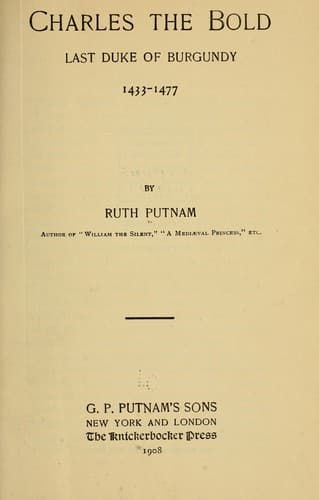
Charles the Bold, Last Duke of Burgundy, 1433-1477Putnam, Ruth
History
Charles the Bold, Last Duke of Burgundy, 1433-1477
Putnam, Ruth
Burgundy (France) -- History; Charles, Duke of Burgundy, 1433-1477; Switzerland -- History -- 1032-1499
Again the rumour that the final straw that broke the emperor's
resolution was the duke's desire to take Savoy and Guelders from
his hand alone, is suggestive. On the duke's part, this wish might
indicate an attempt to separate a portion of territory from the empire
in a way to deceive his contemporaries into thinking that his kingdom
was an imperial fief, while, in reality, it was an independent realm,
as he or his successors could declare at a convenient moment. But this
seems at variance with his attested desire for electoral support.
It was a curious tangle and never fully unravelled. Yet, considering
the emperor's personal characteristics, his last action does not
seem inexplicable. As his visitor showed the intensity of his will,
Frederic became restive. Phlegmatic, obstinate, yet conscious of his
own weakness, personal conflicts with a nature equally obstinate and
much more vigorous were exceedingly unpleasant. The collision made him
writhe uneasily and prefer to slip out of his embarrassment as quietly
as he could.
The proposed leave-taking was to be very magnificent, and the
magnificence again was significant of Burgundian wealth. Whether the
duke would surely keep his pledge of sharing that wealth with the
archduke if the emperor went so far that he could not draw back, was a
consideration that undoubtedly may have affected Frederic. Had Mary of
Burgundy accompanied her father, had the wedding of the daughter and
investiture of the new king been planned for the same day, had the
promises been exchanged simultaneously, the leave-taking might have
passed, indeed, as a third ceremonial in all stateliness.
If Frederic doubted the surety of his bargain, it is not surprising.
It was notorious how the duke had played fast and loose with his
daughter's hand, withdrawing it from the grasp of a suitor as the
greater advantages of another alliance were presented to him, or as
the mere disadvantage of any marriage at all became unpleasantly near.
Vigorous man of forty that he was, Charles had no personal desire to
see a son-in-law, _in propria persona_, waiting for his shoes--a fact
perfectly patent to the emperor, as it was to the rest of the world.
The task of making the imperial adieux was entrusted to the imperial
chamberlain, Ulrich von Montfort, who duly presented his master's
formal excuses to the duke, on the morning of November 25th.
"Important and urgent affairs had necessitated his presence elsewhere.
The arrangement discussed between them was not broken but simply
postponed until a more convenient occasion rendered its execution
possible," etc.
Public-domain text, read in full here on John Shaqi.
Reviews
Reviews
No reviews yet
Be the first to share your thoughts on this work.
Elsewhere in the archive
Join the Discussion
Join the discussion
Sign in to leave a comment or review.
Sign InorCreate an account