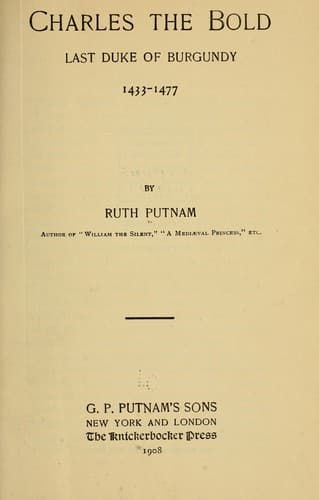
Charles the Bold, Last Duke of Burgundy, 1433-1477Putnam, Ruth
History
Charles the Bold, Last Duke of Burgundy, 1433-1477
Putnam, Ruth
Burgundy (France) -- History; Charles, Duke of Burgundy, 1433-1477; Switzerland -- History -- 1032-1499
The Strasburg chronicles report that Charles was in a towering rage on
receiving this communication. He clinched his fists, ground his teeth,
and kicked the furniture about the room in which he had locked himself
up.[21] But by the time these words were penned, these authors
were better informed than Charles about the ultimate result of the
emperor's intentions. The duke may have been angry, but he certainly
controlled himself sufficiently to give several audiences in the
course of the day--to envoys from Lorraine among others--and was ready
to take his own departure by evening, not doubting that the crown and
sceptre, carefully packed with the mountain of his valuable treasure,
would assuredly fulfil their destiny in the near future. Trèves was
left to its pristine repose, and Charles was the last man to realise
that in its silence were entombed for ever his chances of wearing the
prematurely prepared insignia.
[Footnote 1: This comment of the Strasburg chronicler, Trausch, is
quoted by De Bussière in his _Histoire de la Ligue contre Charles le
Téméraire_, p. 64. Kirk (ii., 222) points out that this contemporary
had a peculiar hostility towards Charles.]
[Footnote 2: Guillaume Faret or Farrel. His _Hist. de René II._ is
lost. This citation from it is found in _La Guerre de René II. contre
Charles le Hardi_, by P. Aubert Roland.]
[Footnote 3: He had been made knight of the Golden Fleece at the
May meeting. From this time on some member of the Nassau family was
prominent in Burgundian affairs.]
[Footnote 4: Gachard, _Doc. inédits_, i., 232. Letter from Trèves,
October 4, 1473.]
[Footnote 5: About this time Louis XI. made strenuous efforts to
unravel the mystery of his brother's death. (Letter to the chancellor
of Brittany, _Lettres de Louis XI_., v., 190.)]
[Footnote 6: Gachard could not explain this phrase. It might easily
refer to the desired investiture.]
[Footnote 7: Chmel, _Mon. Habs_., i., lxxvii., 50, 51: Toutey, p. 50.]
[Footnote 8: Toutey, p. 53.]
[Footnote 9: Toutey bases this statement on three letters (October
30, 31, and November 7, 1473) written by the envoys of the elector of
Brandenburg, Ludwig von Eyb and Hertnid von Stein.]
[Footnote 10: Basin, _Histoire des règnes de Charles VII. et de Louis
XI._, ii., 323. Between Nov. 6th and this ceremony there had been
new ruptures. Hugonet had gone back and forth many times between the
chiefs and "all the world had wondered."]
[Footnote 11: Albert of Brandenburg to the Duke of Saxony. (Muller,
_Reichstag Theatrum_, p. 598.]
[Footnote 12: Toutey, p. 57.]
[Footnote 13: Toutey, p. 60, note.]
[Footnote 14: In this account, differing from the current
tradition, Toutey has followed Bachmann's conclusions (_Deutsche
Reichsgeschichte,_ ii., 435).]
[Footnote 15: Basin, ii., 325.]
Public-domain text, read in full here on John Shaqi.
Reviews
Reviews
No reviews yet
Be the first to share your thoughts on this work.
Elsewhere in the archive
Join the Discussion
Join the discussion
Sign in to leave a comment or review.
Sign InorCreate an account