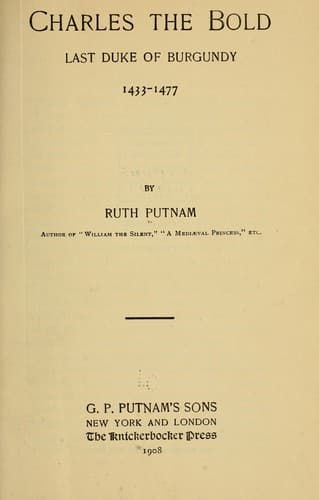
Charles the Bold, Last Duke of Burgundy, 1433-1477Putnam, Ruth
History
Charles the Bold, Last Duke of Burgundy, 1433-1477
Putnam, Ruth
Burgundy (France) -- History; Charles, Duke of Burgundy, 1433-1477; Switzerland -- History -- 1032-1499
The late Duke of Burgundy had attempted to pursue a line of policy in
regard to the ecclesiastical elections in the diocese of Cologne that
had succeeded in Liege and in Utrecht. In 1463, he had tried to force
the chapter to elect his candidate. They had refused to follow
his leading, but their own choice, Robert, brother of the
elector-palatine, did not prove a congenial chief, and the new prelate
turned to Philip for aid when he found his chapter disposed to
restrict both his revenues and his temporal authority. Later, in 1467,
as the audacity of his opponents increased, the archbishop appealed to
his brother, the elector, and to Charles of Burgundy. The latter
was busy in France, but he wrote a sententious letter to Cologne,
exhorting both chapter and city to be obedient to their chosen
spiritual and lay lord. This intervention was resented. The breach
widened between Robert and his people, culminating in actual
hostilities. The chapter took possession of the town of Neuss,
accepted Hermann of Hesse as their protector, and sent an embassy to
Rome to state their grievances. The elector aided his brother and the
belligerent parties grew in strength.
The city of Cologne wavered for a space, undecided which cause to
espouse, and finally chose the chapter's side, signing a five years'
alliance with that body, which had officially renounced allegiance to
Robert, pending the judgment of pope and emperor on the dissension.
Such was the state of affairs when Charles entered into possession of
Guelders and manifested a disposition to interest himself in Cologne.
He informed the chapter that he was greatly displeased with their
contumely. To Cologne he said, "Be neutral," but the burghers showed
so little inclination to heed his neighbourly advice that he tried
harsher measures and permitted Cologne merchants to be molested in his
domains.
In 1473, all hostilities were suspended in the hopes of imperial
intervention.[3] While Charles was still in Guelders, Robert paid
him a visit, held long conferences with him, and probably received
promises of future aid, for he had an air of arrogance when he
returned from the interview. During the sojourn of duke and emperor at
Trèves, a papal legate, the Bishop of Fossombrone, arrived from Rome
with plenary powers to settle Cologne affairs, and his measures were
endorsed by Charles in a letter from Trèves.
For a time Frederic III. seemed inclined to refrain from interference,
then something influenced him in another direction. When he arrived
at Cologne in November, he received a warm welcome and costly gifts,
which he repaid by conferring a mass of privileges on his "good
city,"--cheap and easy benefits,--but he did not prove an efficient
arbitrator, simply postponing any decision from day to day, though he
was begged to settle all difficulties before Charles should attempt to
relieve him of the trouble.
Public-domain text, read in full here on John Shaqi.
Reviews
Reviews
No reviews yet
Be the first to share your thoughts on this work.
Elsewhere in the archive
Join the Discussion
Join the discussion
Sign in to leave a comment or review.
Sign InorCreate an account