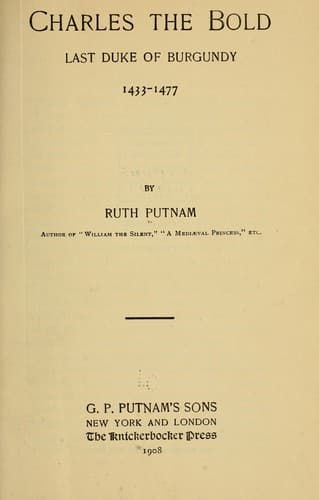
Charles the Bold, Last Duke of Burgundy, 1433-1477Putnam, Ruth
History
Charles the Bold, Last Duke of Burgundy, 1433-1477
Putnam, Ruth
Burgundy (France) -- History; Charles, Duke of Burgundy, 1433-1477; Switzerland -- History -- 1032-1499
True, Charles was detained elsewhere. But he no longer felt the need
of conciliating the emperor, and at Thionville, on December 11, 1473,
he issued a manifesto declaring that his friend Robert was entirely in
the right, his opponents in the wrong.[4] As these latter defied papal
legate and arbitrator duly authorised to settle the points of dispute,
he, Charles of Burgundy, would constitute himself defender of the
insulted archbishop. At the same time, he despatched Ètienne de Lavin
to check the encroachments of the insolent rebels. The declaration
emboldened Robert to defy the emperor's summons to meet him and the
papal legate. They both declared that they would take measures to
bring him to obedience, but Frederic did not wish to tarry longer at
Cologne. In January he took his departure, having directed Hermann of
Hesse to protect that see against all aggression.
Apparently, at that time, in spite of the manifesto, there was no
formal treaty between Charles and Robert, but there are two drafts for
such a treaty in existence,[5] wherein the former pledged himself to
force chapter, nobles, and city to submission, in consideration of the
sum of 200,000 florins, while the archbishop gave permission to his
ally to garrison all strongholds, including Cologne. Pending his
autumn sojourn in the upper Rhinelands, Charles had, therefore, plans
regarding Cologne definitely in mind.
_Lorraine_
This duchy was even more interesting to Charles than Cologne, and
there were many matters in its regard which demanded his urgent
attention in 1473. It, too, was a pleasant territory, and conveniently
adjacent to Burgundian lands. A natural means of annexation had been
considered by Charles in the proposed marriage between Nicholas, Duke
of Lorraine, and Mary of Burgundy. When that project was abandoned to
suit Charles's pleasure, he retained the friendship of his rejected
son-in-law until the latter's death in the spring of 1473. So
unexpected was this event, that there was the usual suspicion of
poisoning, and this crime, too, was charged to the account of Louis
XI., apparently without foundation. Certainly that monarch reaped
no immediate advantage from the death, for the family to whom the
succession passed was more friendly to Burgundy than to France.
The heir to the childless Nicholas was his aunt Yolande of Anjou,
daughter of old King René of Anjou, sister to the unfortunate
Margaret, late Queen of England, and widow of the Duke of Vaudemont.
The council of Lorraine lost no time in acknowledging Yolande as their
duchess. She hastened to Nancy, the capital, with her son René, aged
twenty-two, where they were received hospitably, and then Yolande
formally abdicated in favour of the young man, who was duly accepted
as Duke of Lorraine.
Public-domain text, read in full here on John Shaqi.
Reviews
Reviews
No reviews yet
Be the first to share your thoughts on this work.
Elsewhere in the archive
Join the Discussion
Join the discussion
Sign in to leave a comment or review.
Sign InorCreate an account