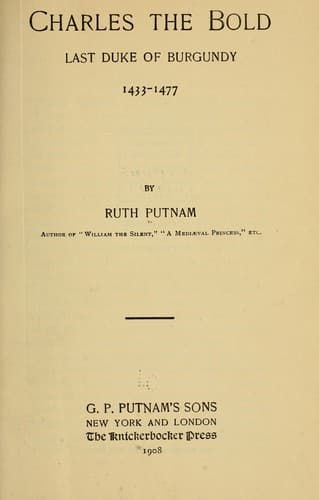
Charles the Bold, Last Duke of Burgundy, 1433-1477Putnam, Ruth
History
Charles the Bold, Last Duke of Burgundy, 1433-1477
Putnam, Ruth
Burgundy (France) -- History; Charles, Duke of Burgundy, 1433-1477; Switzerland -- History -- 1032-1499
The ally certainly became more exigeant. In various towns on the
Moselle, Épinal, Charmes, Dompaire, etc., the Lorraine soldiers were
replaced by Burgundians. This immediate and arrogant use of the rights
he had wrested from the Duke of Lorraine alienated many who had been
warm for Burgundy. René himself admired Charles as Maximilian had
done. The strong man exercised a fascination over both youths, but
the duke did not turn this admiration into real friendship,
underestimating the character of his protégé. His measures, too, were
taken without the slightest consideration for local feeling. Garrison
after garrison was installed and commanded to obey his officers alone,
while the soldiers were allowed to levy their own rations, equivalent
to raids on a friendly country. As always, the agglomeration of
mercenary companies was difficult to control. The duke did not succeed
in having those remote from his jurisdiction kept in due restraint.
Complaints began to pour into his headquarters. Public sentiment
shifted day by day. The Burgundian became the personification of a
public foe. Before Charles proceeded on his way to Alsace, René had
begun to lose his admiration and it was not long before he impatiently
awaited an opportunity to break with his too doughty protector.
_Alsace_
During the four years that Charles had delayed in coming to look at
the result of the bargain of 1469 in the Rhine valley, his lieutenant,
Peter von Hagenbach, had given the inhabitants reason to regret
the easy-going absentee Austrian seigneurs. Much had been done,
undoubtedly, in restraining the lawlessness of the robber barons. The
roads were well policed, and safety was assured to travellers. "I
spy," was the motto blazoned on the livery of the forces led by
Hagenbach up and down the land, until he had unearthed lurking
vagabonds. It was acknowledged that gold and silver could be carried
openly from place to place, and that night journeys were as safe as
day. Still, this advantageous change had not won popularity for the
man who wrought it. Perhaps the people thought it less burdensome to
make their own little bargains with highwaymen or petty nobles,[8] a
law unto themselves, than to meet the rigorous requisitions of the
Burgundian tax collector.
It was the country that had profited most by the new administration.
The small towns had long enjoyed great independence, and had shown
ability in managing their own affairs. They wanted no interference.
Not liked by those whom he had really protected, Hagenbach was
absolutely hated by the burghers who felt his iron hand, without
acknowledging that its pressure had more good than evil in it.
Public-domain text, read in full here on John Shaqi.
Reviews
Reviews
No reviews yet
Be the first to share your thoughts on this work.
Elsewhere in the archive
Join the Discussion
Join the discussion
Sign in to leave a comment or review.
Sign InorCreate an account