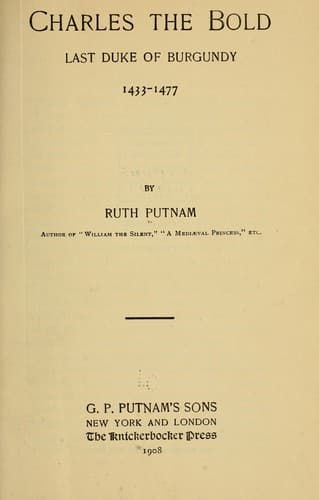
Charles the Bold, Last Duke of Burgundy, 1433-1477Putnam, Ruth
History
Charles the Bold, Last Duke of Burgundy, 1433-1477
Putnam, Ruth
Burgundy (France) -- History; Charles, Duke of Burgundy, 1433-1477; Switzerland -- History -- 1032-1499
Then there were the neighbours to be considered. The Swiss had hated
Sigismund and all Austrians, and had been prepared to prefer Burgundy
as a power in the Rhinelands. But Hagenbach took no pains to win their
friendship. His insolent fashion of referring to them as "fellows" or
"rascals," added to acts of aggression, unchecked if not condoned by
him, aroused bitter dislike to him in the confederated cantons,[9] and
in their allies, Berne, Mulhouse, etc. By 1473, there was a growing
sentiment in Helvetia that they would be happier if Austria had her
own again, while the uneasiness in the cities that stood alone had
greatly increased.
Within Hagenbach's immediate jurisdiction, the opposition to his
measures took a definite form long before the duke's arrival there.
The various commissioners sent by Charles to inspect the quality of
his bargain had all agreed in an urgent recommendation to the duke to
redeem, at the earliest possible moment, all the troublesome mortgages
honeycombing his authority. Hagenbach, too, was fully convinced of the
necessity for this measure, but he was not provided with sufficient
money to accomplish it.
In the spring of 1473, therefore, he resolved to lay a new tax on
wine. This impost, called the "Bad Penny," was bitterly resented for
two reasons. The burden was oppressive to the vintners and it was an
illegal measure, as no sanction had been given by the local estates.
Three towns, Thann, Ensisheim, and Brisac, declared that they were
determined to refuse payment.
Hagenbach marched a force into the Engelburg, a stronghold dominating
Thann, bombarded the town, and took it easily. Thirty citizens were
condemned to death as leaders in an iniquitous rebellion against the
just orders of their lawful governor. Some of these, indeed, were
pardoned, though their estates were confiscated, but five or six
were publicly executed, and their bodies hung exposed to view on the
market-place, as a hideous object-lesson of the cost of resisting
Burgundian orders.
One execution sufficed to render Ensisheim submissive, but Brisac
proved more obstinate. The magistrates there did not resort to force.
They declared there was no need, for they were fully protected by the
article in the treaty of St. Omer, which forbade arbitrary imposition
of any tax on the part of the suzerain. Their determined refusal made
the lieutenant consent to refer the question to the Duke of Burgundy,
and messengers were despatched to Trèves to represent the respective
grievances of governor and governed. The collection of the tax was
postponed until Charles could examine the situation.
Public-domain text, read in full here on John Shaqi.
Reviews
Reviews
No reviews yet
Be the first to share your thoughts on this work.
Elsewhere in the archive
Join the Discussion
Join the discussion
Sign in to leave a comment or review.
Sign InorCreate an account