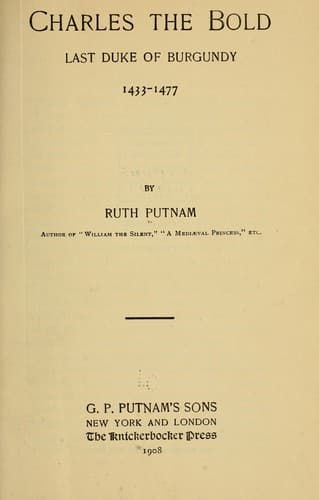
Charles the Bold, Last Duke of Burgundy, 1433-1477Putnam, Ruth
History
Charles the Bold, Last Duke of Burgundy, 1433-1477
Putnam, Ruth
Burgundy (France) -- History; Charles, Duke of Burgundy, 1433-1477; Switzerland -- History -- 1032-1499
Lavish was the display of biblical phrases, like that cited, which
were planted along the ducal way and on a succession of stagings
erected for various exhibits. On the great city square, the platform
was capacious and many actors played out divers roles. Here stood the
scroll-bearing angels on either side of a living representation of
Christ. In the background clustered three separate groups of people
representing, respectively, the three Estates. Above their heads more
inscriptions were to be read.[2] "All the nations desire to see the
face of Solomon," "Behold him desired by all races," "Master, look on
us, thy people," were among the legends.
The stately pageant, in which dignitaries, lay and ecclesiastical,
from other parts of the duke's domains participated, proceeded past
all these soothing insinuations that Charles of Burgundy resembled
Solomon in more ways than one, to the church of St. Benigne. Here
pledges of mutual fidelity were exchanged between the Burgundians and
their ruler. The Abbé of Citeaux placed the ducal ring solemnly
upon Charles's finger as a symbol, and he was invested with all the
prerogatives of his predecessors.
From the church, the train wound its way to the Ste. Chapelle, past
more stages decorated with more flowers of scriptural phrase such as
"A lion which is strongest among beasts and turneth not away for any,"
"The lion hath roared, who will not fear?" "The righteous are as bold
as a lion," etc.
Two days later, the concluding ceremonies of investiture were
performed, and followed by a banquet. Charles was arrayed in royal
robes, and his hat was in truth a crown, gorgeous with gold, pearls,
and precious stones. After a repast, prelates, nobles, and civic
deputies were convened in a room adjoining the dining-hall, where
first they listened to a speech from the chancellor. When he had
finished, the duke himself delivered an harangue wherein he expatiated
on the splendours of the ancient kingdom of Burgundy. Wrongfully
usurped by the French kings, it had been belittled into a duchy, a
measure much to be regretted by the Burgundians. Then the speaker
broke off abruptly with an ambiguous intimation "that he had in
reserve certain things that none might know but himself."[3]
What was the significance of these veiled allusions? It could not have
been the simple scheme to erect a kingdom, because that was certainly
known to many. Charles had, doubtless, an ostrich-like quality of
mind which made him oblivious to the world's vision but even he could
hardly have ignored the prevalence of the rumours regarding the
interview of Trèves, rumours flying north, east, south, and west.
Might not this suggestion of secrets yet untold have had reference to
the ripening intentions of Edward IV. and himself to divide France
between them?
Public-domain text, read in full here on John Shaqi.
Reviews
Reviews
No reviews yet
Be the first to share your thoughts on this work.
Elsewhere in the archive
Join the Discussion
Join the discussion
Sign in to leave a comment or review.
Sign InorCreate an account