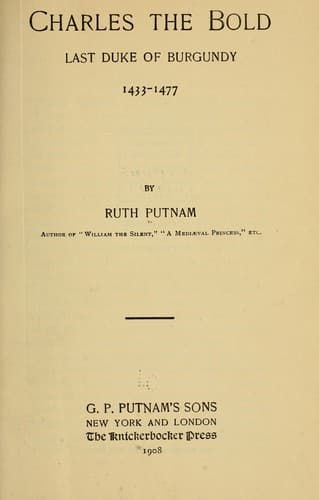
Charles the Bold, Last Duke of Burgundy, 1433-1477Putnam, Ruth
History
Charles the Bold, Last Duke of Burgundy, 1433-1477
Putnam, Ruth
Burgundy (France) -- History; Charles, Duke of Burgundy, 1433-1477; Switzerland -- History -- 1032-1499
When his own induction into his heritage was accomplished, Charles was
ready to pay the last earthly tribute to his parents. A cortège had
been coming slowly from Bruges bearing the bodies of Philip and
Isabella to their final resting-place in the tomb at Dijon, to which
they were at last consigned.[4]
A few weeks more Charles tarried in the city of his birth, and then
went to Dôle where he was invested with the sovereignty of the
Franche-Comté and confirmed the privileges. Thus after seven years of
possession _de facto_, he first actually completed the formalities
needful for the legal acquisition of his paternal heritage. The
expansion of that heritage had been steady for over half a century.
Every inch of territory that had come under the shadow of the family's
administration had remained there, quickly losing its ephemeral
character, so that temporary holdings were regarded in the same light
as the estates actually inherited. At least, Charles, sovereign duke,
count, overlord, mortgagee, made no distinction in the natures of his
tenures. But just as the last link was legally riveted in his own
chain of lands, he was to learn that there were other points of view.
The statement is made and repeated, that the report of the duke's
after-dinner speech at Dijon was a fresh factor in alarming the people
in Alsace and Switzerland about his intentions, and making them hasten
to shake off every tie that connected them with Charles and his
ambitious projects of territorial expansion.[5] As a matter of fact,
there had been for months constant agitation in the councils of the
Swiss Confederation and the Lower Union as to the next action.
Opposition to Sigismund had been long existent, antipathy to Austria
was so deeply rooted that the idea of restoring that suzerainty in the
Rhine valley was slow to gain adherents. Probably the arguments that
came from France were what carried conviction. It was a time when
Louis spared no expense to attain the end he desired, while he posed
as a benevolent neutral.[6] His servants worked underground. Their
open work was very cautious. It was French envoys, however, who
announced to the Swiss Diet, convened at Lucerne, that Sigismund was
quite ready to come to an understanding in regard to an alliance and
the redemption of his mortgaged lands.
Public-domain text, read in full here on John Shaqi.
Reviews
Reviews
No reviews yet
Be the first to share your thoughts on this work.
Elsewhere in the archive
Join the Discussion
Join the discussion
Sign in to leave a comment or review.
Sign InorCreate an account