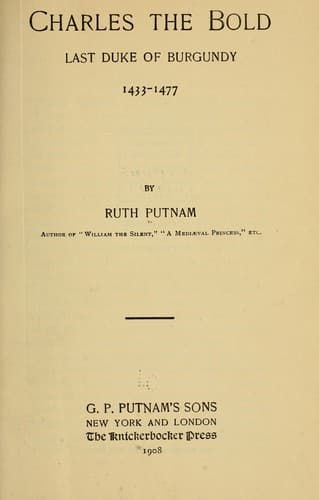
Charles the Bold, Last Duke of Burgundy, 1433-1477Putnam, Ruth
History
Charles the Bold, Last Duke of Burgundy, 1433-1477
Putnam, Ruth
Burgundy (France) -- History; Charles, Duke of Burgundy, 1433-1477; Switzerland -- History -- 1032-1499
Before this letter reached its destination, the duke's deputy in the
mortgaged lands had already found his resources wholly inadequate to
maintain his master's authority. After Charles departed from Alsace,
Hagenbach's increased insolence and abandonment of all the restraint
that he had shown while awaiting the duke's visit soon became
unbearable. The deliberations in Switzerland concerning their return
to Austrian domination also naturally affected the Alsatians and made
them bolder in resenting Hagenbach's aggressions.
Thann and Ensisheim were both firm in refusing admission to his
garrisons. Brisac was in his hands already, and her fortifications
held by mercenaries, but an order to the citizens to work, one and
all, upon the defences, produced a sudden disturbance with very
serious results. It was at Eastertide, and the command to desecrate a
hallowed festival, one especially cherished in the Rhinelands, proved
the final provocation to rebellion.
There is a black story in the Strasburg chronicle, moreover, that this
misuse of Easter Day was not Hagenbach's real crime. He simply
wished to get all combatants out of the city before butchering the
inhabitants and his purpose was discovered in time. That charge does
not, however, seem substantiated by other evidence. But there is no
doubt that the citizens lashed themselves into a state of fury, fell
upon the mercenaries, and killed many of them in spite of their own
unarmed condition. Hagenbach, driven back into his lodgings, appeared
at the window and offered various concessions, being actually humbled
and intimidated by the unexpected turning of the submissive folk
against him.
But the revolutionary spirit raged beyond the reach of conciliatory
words. Some of the more intelligent burghers endeavoured to give a
show of propriety to events, by promptly re-establishing their own
ancient council, arbitrarily abolished by Hagenbach, while taking a
new oath to the Duke of Burgundy, according to the formula of 1469.
They also despatched envoys to the duke with explanations of their
proceedings, stating further that it was Hagenbach's misrule alone to
which protest was made; that they were not in revolt against Charles.
The latter answered, "Send Hagenbach to me," but the provisional
government, by the time they received this order, felt strong enough
to disregard it and to continue to act on their own initiative.
Hagenbach was cast not only into prison but into irons. All fear of
and respect for his authority was thrown to the winds, his offer of
fourteen thousand florins as ransom being sternly refused.
Public-domain text, read in full here on John Shaqi.
Reviews
Reviews
No reviews yet
Be the first to share your thoughts on this work.
Elsewhere in the archive
Join the Discussion
Join the discussion
Sign in to leave a comment or review.
Sign InorCreate an account