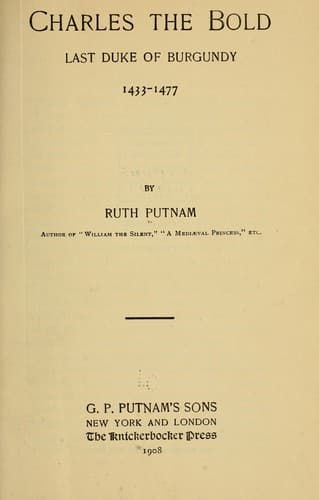
Charles the Bold, Last Duke of Burgundy, 1433-1477Putnam, Ruth
History
Charles the Bold, Last Duke of Burgundy, 1433-1477
Putnam, Ruth
Burgundy (France) -- History; Charles, Duke of Burgundy, 1433-1477; Switzerland -- History -- 1032-1499
That was on January 21, 1474, the very day when the mortgagee was
preparing to ride into Dijon and read the agreeable assurances of his
wisdom, strength, and puissance. Yet a month and Sigismund's envoys
were seated on the official benches at the Basel diet, ranking with
the delegates from the cantons and the emissaries from France. On
March 27th, the diet met at Constance, and for three days a debate
went on which resulted in the drafting of the _Ewige Richtung_,
the _Réglement définitif_, a document which contained a definite
resolution that the mortgaged lands were to be completely withdrawn
from Burgundy, and all financial claims settled. This resolution was
subscribed to by Sigismund and the Swiss cantons. Further, it was
decided to ignore one or two of the stipulations made at St. Omer and
to offer payment to Charles at Basel instead of Besançon.
Meantime that creditor, perfectly convinced in his own mind that
the legends of his birthplace were correct in their rating of his
character and his qualities, again crossed Lorraine and entered
Luxemburg, where he celebrated Easter. It was shortly after that
festival, on April 17th, that a letter from Sigismund was delivered to
him announcing in rather casual and off-hand terms that he was now in
a position to repay the loan of 1469, made on the security of those
Rhinelands. Therefore the Austrian would hand over at Basel 80,000
florins, 40,000 the sum received by him, 10,000 paid in his behalf to
the Swiss, and 30,000 which he understood that Charles had expended
during his temporary incumbency,[7] and he, Sigismund, would resume
the sovereignty in Alsace.
It was all very simple, at least Sigismund's wish was. The expressions
employed in the paper were, however, so ambiguous, the language so
involved, that Charles expended severe criticism on his cousin's style
before he proceeded to answer his subject-matter. To that he replied
that the bargain between him and Sigismund was none of his seeking.
The latter had implored his protection from the Swiss, had begged
relief in his financial straits. Touched by his petitions, Charles
had acceded to his prayers and the lands had enjoyed security under
Burgundian protection as they never had under Austrian. Charles had
duly acquitted himself of his obligations, he had done nothing to
forfeit his title. The conditions of redemption offered by Sigismund
were not those expressly stipulated. If a commission were sent to
Besançon, the duke would see to it that the merits of the case were
properly examined.
"If, on the contrary, you shall adhere to the purpose you have
declared, in violation of the terms of the contract and of your
princely word, we shall make resistance, trusting with God's help that
our ability in defence shall not prove inferior to what we have used
to repulse the attacks of the Swiss--those attacks from which you
sought and received our protection."
Public-domain text, read in full here on John Shaqi.
Reviews
Reviews
No reviews yet
Be the first to share your thoughts on this work.
Elsewhere in the archive
Join the Discussion
Join the discussion
Sign in to leave a comment or review.
Sign InorCreate an account