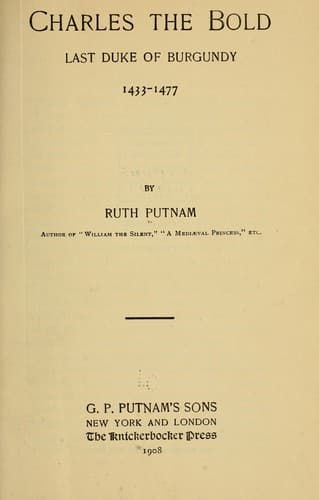
Charles the Bold, Last Duke of Burgundy, 1433-1477Putnam, Ruth
History
Charles the Bold, Last Duke of Burgundy, 1433-1477
Putnam, Ruth
Burgundy (France) -- History; Charles, Duke of Burgundy, 1433-1477; Switzerland -- History -- 1032-1499
It is after this incident that the astute Panigarola returns and joins
the duke's suite at Salins. He finds Charles a changed man, indulging
in strange fits of hilarity, expressing the wish that a couple of
thousand more of his troops had been killed, "French at heart" as they
were. He refused to see Yolande, after thus forcibly obtaining the
means of so doing, and sent her to the castle of the Sire of Rochefort
for safe-keeping. Abstemious as he had been all his life, never taking
wine without water, the strong Burgundy in which he now suddenly
indulged went to his head.
Rumours went abroad that his mental balance was shaken. That does
not seem to have been true to the extent of insanity. He was only
infinitely chagrined but he certainly put on a brave front and
retained his self-confidence and declared
"They are wrong if they believe me defeated. Providence has
provided me with so many people and estates with such abundant
resources, that many such defeats would be needed to ruin them. At
the moment when the world imagines that I am annihilated, I will
reopen the campaign with an army of 150,000 men."[22]
[Footnote 1: _Lettres de Louis XI_., v., 368.]
[Footnote 2: _Nos omnes relinquens, Ibid_., 371.]
[Footnote 3: Commynes-Dupont, i., 336.]
[Footnote 4: _Lettres_, v., 363. Louis to Dammartin.]
[Footnote 5: Gachard, _Doc. inéd_., i., 249.]
[Footnote 6: Commines, iv., ch. vi.]
[Footnote 7: Commines, iv., ch. viii.: Comines-Lenglet, ii., 217.]
[Footnote 8: The terms of the treaty provided for a seven years'
truce, with international free trade and mutual assistance in civil
or foreign wars of either monarch. Louis's complaisance went so far
that he did not insist on Edward's renouncing the title of King of
England and France.]
[Footnote 9: _The Paston Letters_. Sir John Paston to his mother,
Sept. 11, 1475.]
[Footnote 10: The story must be omitted here. The constable was
finally apprehended, tried, and executed at Paris.]
[Footnote 11: _Dépêches Milanaises_, i., 253. The copy only is at
Milan and there is no seal.]
[Footnote 12: Toutey, p. 380.]
[Footnote 13: _Dép. Milan_., i., 266.]
[Footnote 14: _Dép. Milan_., i., 300.]
[Footnote 15: Jomini lays the defeat to a tactical error. "Charles had
committed the fault of encamping with one wing of his army resting on
the lake, the other ill-secured at the foot of a wooded mountain.
Nothing is more dangerous for an army than to have one of its wings
resting on an unbridged stream, on a lake, or on the sea." Charles
explained to Europe that he had been surprised, and his defeat was a
mere bagatelle.]
[Footnote 16: III., 216.]
[Footnote 17: Embossed ornaments.]
[Footnote l8: _Dép. Milan._, ii., 126.]
[Footnote 19: _Dép. Milan._, ii., 335.]
[Footnote 20: _Dep. Milan_., ii., 295.]
[Footnote 21: III., 234.]
[Footnote 22: _Dep. Milan_, ii., 339.]
CHAPTER XXI
THE BATTLE OF NANCY
1477
Public-domain text, read in full here on John Shaqi.
Reviews
Reviews
No reviews yet
Be the first to share your thoughts on this work.
Elsewhere in the archive
Join the Discussion
Join the discussion
Sign in to leave a comment or review.
Sign InorCreate an account