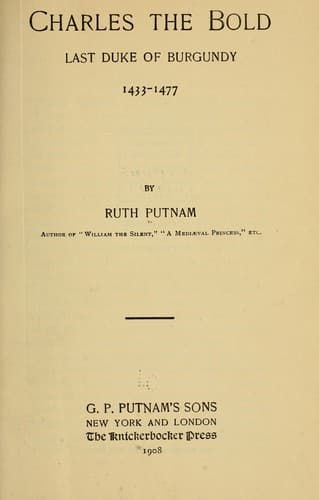
Charles the Bold, Last Duke of Burgundy, 1433-1477Putnam, Ruth
History
Charles the Bold, Last Duke of Burgundy, 1433-1477
Putnam, Ruth
Burgundy (France) -- History; Charles, Duke of Burgundy, 1433-1477; Switzerland -- History -- 1032-1499
It was manifestly impossible for Charles to attempt to retrieve his
fortunes without having large sums of ready money at his command.
He therefore proceeded to appeal to the guardians of each and every
treasury in his various states. Flanders and Burgundy were, however,
the only quarters whence succour was in the least probable. The
Estates of the latter duchy met, deliberated, and resolved to make no
pretence nor to "yield anything contrary to the duty which every one
owes to his country."[1] A certain Sieur de Jarville, accompanied
by other true Burgundians, undertook to report the proceedings to
Charles,--a duty usually falling to the share of the presiding officer
of the ecclesiastical chamber. The message which he carried was
laconic but sturdy:
"Tell Monsieur that we are humble and brave subjects and servitors,
but as to what is asked in his behalf, it never has been done, it
cannot be done, it never will be done."
"Small people would never dare use such language," is the comment
of the Burgundian chronicler, proud of the temerity of his fellow
countrymen.
In the Netherlands, the individual Estates were equally emphatic in
their refusal to meet the duke's wishes. Charles, therefore, resolved
to call together a general assembly of deputies in the hope of finding
them, collectively, more amenable. Writs of summons were issued very
widely and a "States-general" was formally convened at Ghent on
Friday, April 26, 1476.[2] At the last assembly of this nature, in
1473, the duke had expressly promised, in consideration of an annual
grant of 500,000 crowns for six years then accorded to him, to refrain
from further demands, and there was a spirit of sullen resentment in
the air when this session, whose purpose was plain, was opened by
Chancellor Hugonet. He set forth three points for consideration.
Monseigneur wished his daughter Mary, "that most precious jewel," to
join him in Burgundy. A suitable escort was necessary to ensure her
safe journey and that the duke requested the States to provide.
Secondly he desired the States to endorse a levy of fresh troops to
meet his immediate requirements. Further, he requested each town to
equip a specified number of horses at its own expense; he demanded the
service of his tenants, fief and arrière-fief; and, in addition, he
required that all other men, no matter what their condition, able to
bear arms, should enlist or provide a substitute. A portion of the
troops should be set to guard the frontier, and the rest should be
sent to the duke in Burgundy.
It was a demand pure and simple for a universal call to arms, a
national levy. The duke's paternal desire to see his daughter was the
flimsiest of excuses that deceived no one for a moment.
After the chancellor's exposition there was probably adjournment for
discussion. The pensionary of Brussels, Gort Roelants, then acted as
spokesman to present the following report, as the result of their
deliberations, to the duchess-regent.
Public-domain text, read in full here on John Shaqi.
Reviews
Reviews
No reviews yet
Be the first to share your thoughts on this work.
Elsewhere in the archive
Join the Discussion
Join the discussion
Sign in to leave a comment or review.
Sign InorCreate an account