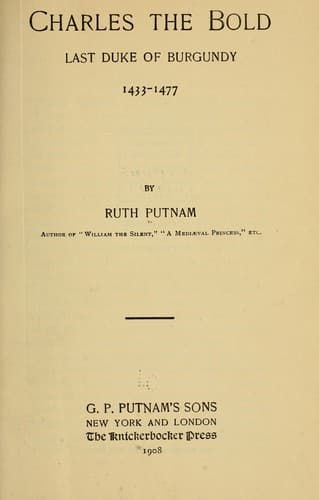
Charles the Bold, Last Duke of Burgundy, 1433-1477Putnam, Ruth
History
Charles the Bold, Last Duke of Burgundy, 1433-1477
Putnam, Ruth
Burgundy (France) -- History; Charles, Duke of Burgundy, 1433-1477; Switzerland -- History -- 1032-1499
As for Mlle. of Burgundy, the deputies would ascertain the wishes
of their principals, but the second request did not call for a
referendum. The representatives were fully capable of settling the
matter at once. Considering the heavy burdens laid on the people, and
taking into account the promises made to them in 1473, that no
further demands should be made on the public purse, the three Estates
concurred in humbly petitioning Monseigneur to excuse them from
granting his request.
It was on a Sunday after dinner (April 28th) when this decision was
communicated to the duchess in her own hotel. After a private colloquy
between her and Hugonet, the chancellor told the messenger that it was
quite right for the deputies to consult their principals before the
heiress was permitted to leave the guardianship of her faithful
subjects. That was a grave matter, but surely there was no reason why
her "escort" could not be determined upon at once. In regard to the
levies, Madame was not empowered to take any excuse. It was beyond her
province. Since the opening of the assembly, fresh letters had
arrived from the duke urging the speedy execution of his previous
instructions. The chancellor then appointed a committee to meet a
committee from the States at 8 A.M. on the morrow at the convent of
the Augustines.
This was not satisfactory. Hugonet was speedily notified that the
States did not feel empowered to appoint a committee. The most they
could do was to resolve themselves into a committee of the whole. The
objection to this was that a small conference was far better suited
to free discussion. It was easy for unqualified persons to enter the
session of a large body. The States, however, were tenacious in their
opinion that their writs did not qualify them to appoint committees.
Every point must be threshed out in the presence of every deputy.
_Potestas delegata non deleganda est_.
[Illustration: PHILIBERT, DUKE OF SAVOY (AFTER THE DESIGN BY MATHEY)]
There was further negotiation, and it was not until Monday afternoon
that Hugonet's commissioner brought a conciliatory message that if the
gentlemen were so bent on it, he would, in spite of the difficulty of
discussion in an open meeting, talk over both points with them in
full assembly. Again the States objected. They had no instructions
whatsoever in regard to Mademoiselle, and could not discuss her
movements either in public or in private session. As to levies, they
repeated in detail all previous arguments, and expressed a fervent
hope that Monseigneur would withdraw the request. It would, in the
end, be more to Monseigneur's advantage, etc. Back and forth travelled
the commissioner between States and duchess. The latter simply
reiterated her dictum that Mary must certainly set forth to visit her
father in May, with an adequate escort, in whose ranks must appear
three prelates, three or four barons, fifty knights, and notable men
from the "good towns," well armed.
Public-domain text, read in full here on John Shaqi.
Reviews
Reviews
No reviews yet
Be the first to share your thoughts on this work.
Elsewhere in the archive
Join the Discussion
Join the discussion
Sign in to leave a comment or review.
Sign InorCreate an account