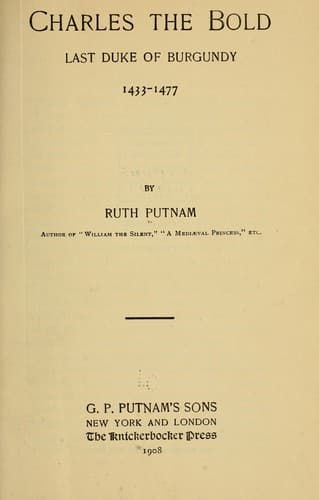
Charles the Bold, Last Duke of Burgundy, 1433-1477Putnam, Ruth
History
Charles the Bold, Last Duke of Burgundy, 1433-1477
Putnam, Ruth
Burgundy (France) -- History; Charles, Duke of Burgundy, 1433-1477; Switzerland -- History -- 1032-1499
In the succeeding weeks Louis plunged deeper and deeper into
negotiations with any and every one whom he could turn against
Charles. In October, Sire de Chamont, governor of Champagne, --the
territory that Edward IV. had failed to consign to the duke's
sovereignty,--made a descent on Rouvre and rescued Yolande of Savoy.
There was no attempt to stay her departure, and she was scrupulous, so
it is said, in leaving money behind to pay for the Burgundian property
carried off in her train--though it were nothing but an old crossbow.
"Welcome, Madame the Burgundian," was the fraternal salutation which
she received on her arrival at her brother's court. She replied that
she was a good French woman and quite ready to obey his majesty's
commands.[10]
During the summer, Charles remained at La Rivière exerting every
effort to levy an army. It was no easy task, and the review held on
July 27th showed a meagre return for his exertions. But he did not
slacken his efforts. Lists were immediately drawn up showing the
vacancies in each company, and his money stress did not prevent
his offering increased pay as an extra inducement to recruits. "An
excellent means of encouragement," comments Panigarola.
The necessity for his preparations was evident. An opportune legacy
inherited by René of Lorraine enabled that dispossessed prince to work
to better advantage than he had been able to do since Charles had
convened the Estates of Lorraine at Nancy. Moreover, on the very day
of the review of the deficient Burgundian troops, a Swiss diet at
Fribourg adopted resolutions regarding, a closer alliance with
René.[11] Louis XI. ostensibly maintained his truce with Charles but
he had intimated that a French army would wait in Dauphiné ready "to
help adjust the affairs of Savoy," and, at about the same time when
Yolande was at court, he gave a gracious reception to a Swiss embassy,
so that René did not feel himself without support as he advanced to
recover his city.
The mercenaries left by Charles at Nancy were weak and indifferent--a
brief siege, and the capital of Lorraine capitulated to Duke René.
Charles was too late to prevent this mortifying loss. His forces, too,
were a mere shadow. Three to four thousand men rallied round him in
the Franche-Comté, a few hundred joined him in Burgundy, and as he
skirted the frontier of Champagne he received slight reinforcements
from Luxemburg. Then came Campobasso and his mercenary troops, and
the Count of Chimay with such Flemish fiefs as had, individually,
respected the duke's appeal. In all, the forces at Charles's
disposition amounted to about ten thousand, far fewer than those at
Neuss or at Granson.
Public-domain text, read in full here on John Shaqi.
Reviews
Reviews
No reviews yet
Be the first to share your thoughts on this work.
Elsewhere in the archive
Join the Discussion
Join the discussion
Sign in to leave a comment or review.
Sign InorCreate an account