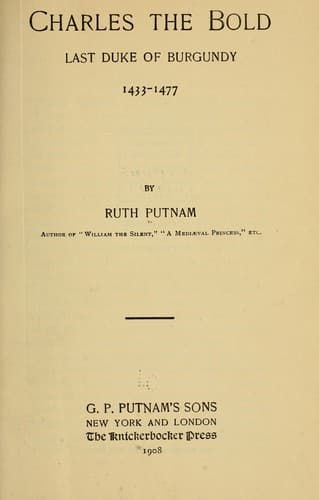
Charles the Bold, Last Duke of Burgundy, 1433-1477Putnam, Ruth
History
Charles the Bold, Last Duke of Burgundy, 1433-1477
Putnam, Ruth
Burgundy (France) -- History; Charles, Duke of Burgundy, 1433-1477; Switzerland -- History -- 1032-1499
At a diet of October 17th, the compact between René and the Swiss was
confirmed, and the former was assured of efficient aid to help him
repulse Charles in his advance into Lorraine. There was need. The city
of Toul refused admission to both dukes, but furnished provision for
Charles's troops, so that for the moment he was the better off of the
two. René then proceeded to provision Nancy and to prepare it for a
siege, while he himself proceeded to Pont-à-Mousson, and for several
days the two adversaries were only separated by the Moselle. Charles's
army was augmented daily by slight accessions from Flanders, and
England, and by fragments of the garrisons of the towns in Lorraine
that had yielded to René and the latter fell back, little by little.
Charles in his turn held Pont-à-Mousson, and proceeded along the road
to Nancy, not deterred by the Lorrainers.
It was on October 22nd, that Charles of Burgundy laid siege for the
second time to Nancy. In thus entering into active hostilities, he was
ignoring the advice of his councillors who were unanimous in begging
him to devote the winter months to refitting his army in Luxemburg or
Flanders. His position was really very dangerous. He had no base on
which to rest as he had recovered no towns except Pont-à-Mousson. But
he ignored the patent obstacles and tried assault after assault upon
Nancy--all most valiantly repulsed. Within the walls, there was an
amazing display of courage, energy, and good humour. As a matter of
fact, the duke's reputation had waned, while the fear of his cruelty
emboldened the burghers to hold out to the last ditch. Any fate would
be better than falling into his hands, was the general opinion.
Throughout Lorraine, the captains of the garrisons seized every
occasion to harry the Burgundians. Familiar with the lay of the land,
with every cross-road and by-path, they were able to lie in wait for
the foragers and to do much damage. Four hundred cavaliers, coming
up from Burgundy, were attacked by one Malhortie de Rozière, and
literally cut to pieces, while their horses changed sides with ease.
Only a few escaped to report the fate of the others to Charles. Not
long after, Malhortie, encouraged by this success, crept up to the
Burgundian camp, fell upon the sleepers, and captured a goodly number
of horses.
The troops on which Charles counted most confidently were
Campobasso's. Several attempts were made to warn him that treachery
was possible in that quarter if the commander were too much
exasperated by delays in payment, too much tried by the ill-temper of
his employer. But the duke persisted in being oblivious to what was
passing under his eyes. Thus, while awaiting the moment for his final
defection, the Italian found it possible to enter into communication
with René and to retard the operations of the siege so as to give time
for the advance of the army of relief.
Public-domain text, read in full here on John Shaqi.
Reviews
Reviews
No reviews yet
Be the first to share your thoughts on this work.
Elsewhere in the archive
Join the Discussion
Join the discussion
Sign in to leave a comment or review.
Sign InorCreate an account