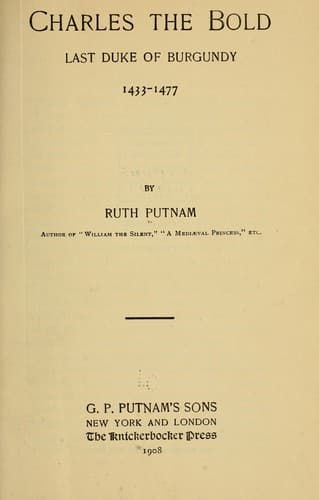
Charles the Bold, Last Duke of Burgundy, 1433-1477Putnam, Ruth
History
Charles the Bold, Last Duke of Burgundy, 1433-1477
Putnam, Ruth
Burgundy (France) -- History; Charles, Duke of Burgundy, 1433-1477; Switzerland -- History -- 1032-1499
The chief provisions were as follows: The deans of the gilds were
deprived of participation in the election of sheriffs. The privileges
of the naturalisation laws were considerably abridged. No sentence of
banishment could be pronounced without the intervention of the duke's
bailiff, whose authorisation, too, was required before the publication
of edicts, ordinances, etc. The sheriffs were forbidden to place their
names at the head of letters to the officers of the duke. The banners
were to be delivered to the duke and placed under five locks, whose
several keys should be deposited with as many different people,
without whose consensus the banners could not be brought forth to lead
the burghers to sedition. One gate was to be closed every Thursday in
memory of the day when the citizens had marched through it to attack
their liege lord, and another was to be barred up in perpetuity or
at the pleasure of their sovereign. To reimburse the duke for his
enforced outlay, a heavy indemnity was to be paid by the city.
July 30th was the date appointed for the final act of submission, the
_amende honorable_ of the unfortunate city. The scene was very similar
to that played at Bruges in 1440. Two thousand citizens headed by the
sheriffs, councillors, and captains of the burgher guard met the
duke and his suite a league without the walls of Ghent. Bareheaded,
barefooted, and divested of all their robes of office and of dignity,
clad only in shirts and small clothes, these magistrates confessed
that they had wronged their loving lord by unruly rebellion, and
begged his pardon most humbly.
The duke spent the night of July 29th at Gaveren, prepared to march
out in the morning with his whole army in handsome array. Philip was
magnificently apparelled, but he rode the same horse which he had used
on the day of battle, with the various wounds received on that day
ostentatiously plastered over to make a dramatic show of what the
injured sovereign had suffered at the hands of his disloyal subjects.
The civic procession was headed by the Abbot of St. Bavon and the
Prior of the Carthusians. The burghers who followed the half-clad
officials were fully dressed but they, too, were barefoot and
ungirdled. All prostrated themselves in the dust and cried, "Mercy on
the town of Ghent." While they were thus prostrate, the town spokesman
of the council made an elaborate speech in French, assuring the
duke that if, out of his benign grace. he would take his loving and
repentant subjects again into his favour, they would never again give
him cause for reproach.
"At the conclusion of this harangue, the duke and the Count of
Charolais, there present, pardoned the petitioners for their evil
deeds. The men of Ghent re-entered their town more happy and
rejoiced than can be expressed, and the duke departed for Lille,
having disbanded his army, that every one might return to their
several homes." [19]
Public-domain text, read in full here on John Shaqi.
Reviews
Reviews
No reviews yet
Be the first to share your thoughts on this work.
Join the Discussion
Join the discussion
Sign in to leave a comment or review.
Sign InorCreate an account