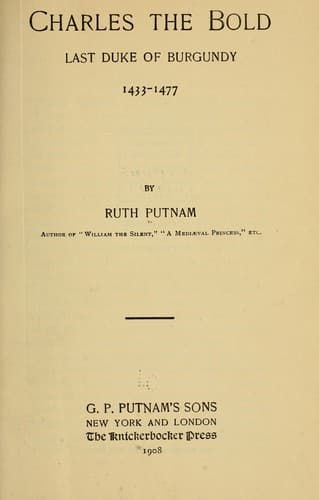
Charles the Bold, Last Duke of Burgundy, 1433-1477Putnam, Ruth
History
Charles the Bold, Last Duke of Burgundy, 1433-1477
Putnam, Ruth
Burgundy (France) -- History; Charles, Duke of Burgundy, 1433-1477; Switzerland -- History -- 1032-1499
On that fatal fifth of January, Charles of Burgundy had only just
passed middle life. He was forty-four years, one month, and twenty-six
days old, an age when a man has the right to look forward to new
achievements. Every circumstance of the dreary and premature death was
in glaring contrast to his prospects at his birth in 1433, in insolent
contradiction to his own estimation of the obligations assumed by Fate
in his behalf. In certain details of the catastrophe there are, of
course, accidents. No one could have predicted that the duke whose
chief title was a synonym for magnificence, that this cherished heir
to his House, who had been bathed in all the luxury known to his
epoch, should have thus lain in death, many hours long, unattended and
uncared-for, naked and frozen on a bed of congealed mud, with a winter
sky as canopy. The actual adversity as it overwhelmed him was too
appalling for any foresight. But the great dream of the man's life
that vanished with his vitality owed its annihilation to no mere
chance of warfare. Had it not been rudely ended by the battle of
Nancy, other means of destruction, inevitable and sure, would have
appeared. The projected erection of a solidified kingdom stretching
from the North Sea to Switzerland and possibly to the Mediterranean,
one that could hold the balance of power between France and Germany,
contained elements of disintegration, latent at its foundation. It is
clear, from a consideration of the Duke of Burgundy and his position
in the Europe of his time, that the materials which he expected to
mould into a realm were a collection of sentient units. Each separate
one was instinct with individual life, individual desires, conscious
of its own minute past, capable of directing its own contracted
future. That the hereditary title of overlord to each political unity
had lodged upon a head already dignified by a plurality of similar
titles, was a mere chance and viewed by the burghers in a wholly
different light from that in which this same overlord regarded it. The
fishers in Holland, the manufacturers in Brabant, the merchants in
Flanders, the vintners in Burgundy, cared nothing for being the wings
of an imperial idea. They wanted safe fishing grounds, unmolested
highways of commerce, vineyards free from the tramp of armies. And
with their desires fixed on these as needful, their attitude towards
the political centralisation planned by their common ruler, often
betrayed both ignorance and inconsistency. At various epochs some
degree of imperialism for the Netherland group had been quite to
popular taste. In Holland, Zealand and Hainaut, it had been conceded
that Jacqueline of Bavaria was less efficient to maintain desirable
conditions than her cousin of Burgundy, and the exchange of sovereigns
had been effected in spite of the manifest injustice involved in the
transaction. But while there was willingness to accept any advantages
that might accrue to a people from the reputation of a local overlord,
Public-domain text, read in full here on John Shaqi.
Reviews
Reviews
No reviews yet
Be the first to share your thoughts on this work.
Elsewhere in the archive
Join the Discussion
Join the discussion
Sign in to leave a comment or review.
Sign InorCreate an account