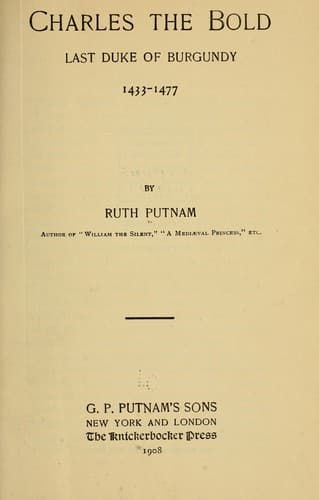
Charles the Bold, Last Duke of Burgundy, 1433-1477Putnam, Ruth
History
Charles the Bold, Last Duke of Burgundy, 1433-1477
Putnam, Ruth
Burgundy (France) -- History; Charles, Duke of Burgundy, 1433-1477; Switzerland -- History -- 1032-1499
it was never forgotten for an instant that his relation to his
subjects was as their own count and strictly limited by conditions
that had long existed within each petty territory. While Charles
seemed to be on the straight road towards his goal, the people within
each body politic of his inherited states were profoundly preoccupied
with their own local concerns, and only alive to his schemes when they
feared demands upon their internal revenues for external purposes.
It does not seem probable, however, that the abstract question of the
projected kingdom was ever taken very seriously among those to be
directly affected by the proposed change. The bars interposed by his
own subjects in the duke's progress towards royalty were obstructions
to his successive steps rather than to his theory. Indeed, strenuous
opposition to details was allied to a vague and passive acceptance of
the whole. Moreover when the idea was phrased it was distinctly as
a revival, not as a novelty. The previous existence of a kingdom of
Burgundy was undoubtedly a potent factor in the degree of progress
made by Charles towards conjuring into new life a reincarnation of
that ancient realm. Yet it was a factor clothed with a shadow rather
than with the substance of truth. Geographically there was very little
in common between the dominion projected more or less definitely in
1473 and any one of the kingdoms of Burgundy as they had successively
existed. That of Charles corresponded very nearly to the ancient
kingdom of Lorraine. Franche-Comté was the only ground common to the
territories actually held by the duke and to the latest kingdom of
Burgundy. His possessions in Picardy and Alsace lay wholly beyond the
limits of either Burgundy or Lorraine. But the old name survived in
his ducal title, and it was that name that lent a semblance of reality
to this fifteenth-century dream of a middle kingdom as outlined in the
duke's mind more or less definitely or as bounded by his ambition.
In retrospect it is clear that more was requisite for the realisation
of the vision of the wished-for nation, than imperial investiture of
a crowned monarch with sovereignty over a group of lands. A modern
writer has pointed out how infinitely subtle is the vital principle
of a nation, one not even to be created by common interests. A
_Zollverein_ is no _patria_. An element of sentiment is needful, and
an element of growth.[23] The nation like the individual is the result
of what has gone before. An heroic past, great men, glory that can
command respect at home and abroad--that is the capital on which
is based a national idea. To have wrought in common, to wish to
accomplish more in the future, are essential conditions to be a
people. "The existence of a nation is a plebiscite of every day, just
as the existence of the individual is a perpetual affirmation of
life."
Public-domain text, read in full here on John Shaqi.
Reviews
Reviews
No reviews yet
Be the first to share your thoughts on this work.
Elsewhere in the archive
Join the Discussion
Join the discussion
Sign in to leave a comment or review.
Sign InorCreate an account