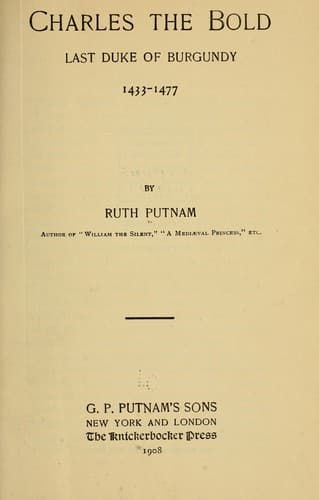
Charles the Bold, Last Duke of Burgundy, 1433-1477Putnam, Ruth
History
Charles the Bold, Last Duke of Burgundy, 1433-1477
Putnam, Ruth
Burgundy (France) -- History; Charles, Duke of Burgundy, 1433-1477; Switzerland -- History -- 1032-1499
Thus at home as well as abroad the last Duke of Burgundy tried to
stand alone. Perhaps his chief happiness in life was that he never
knew how insufficient for his desired task he was and how the new art
of printing, the birth of Erasmus of Rotterdam, were the really great
events of his brief decade of sovereignty. It was his good fortune
that he never knew that no splendid achievement gave significance to
his device: "I have undertaken it"--_Je lay emprins_.
[Footnote 1: _Mém. de la soc. bourg. de géog. et d' hist_. Article by
A. Cornereau, vi., 229.]
[Footnote 2: Les états de Gand en 1476. (Gachard, _Études et notices
hist,. des Pays-Bas_, i., I.)
This is a study of the report made by Gort Roelants, pensionary of
Brussels, one of the deputies to the assembly of 1476. This so-called
"States-general" was by no means a legislative assembly. When Philip
the Good convened deputies from the various states at Bruges in 1463,
it was to save himself the trouble of going to the separate capitals
to ask for _aides_. Assemblies of similar nature occurred several
times before 1477, when Mary of Burgundy granted the privilege of
self-convention and when a constitutional rôle was assured to the
body; though not used for many years (_See_ Pirenne, ii., 379.)]
[Footnote 3: _Pour y penser la nuit jusques aw lendemain_.]
[Footnote 4: _S'ils n'avaient point charge limitée quantefois ils
devaient boire en chemin_.]
[Footnote 5: Compte-rendu par Antoine Rolin, Sr. d' Aymeries, Oct. 1,
1475-Sept. 30, 1476. In the archives of Hainaut there are proofs that
another assembly was confidently expected.]
[Footnote 6: Gingins la Sarra, ii., 354.]
[Footnote 7: _Ibid_., 359. Scorende queste cose come avesse il libro
avanti, parse ad ogniuno imprimesse bene questo suo intento.]
[Footnote 8: Petrasanta to the Duke of Milan Aug. 12th. Quoted in
Kirk, iii., 487.]
[Footnote 9: An Italian phrase signifying to run down his game
slowly.]
[Footnote 10: Commines, v., ch. iv.]
[Footnote 11: Toutey calls the diet at Fribourg a veritable congress
of central Europe, the first of international congresses.]
[Footnote 12: Huguénin Jeune, _Hist. de la guerre de Lorraine_, p.
217.]
[Footnote 13: This monarch, Alphonse V., called the African, asking
Louis XI. for assistance against Ferdinand of Castile, was refused on
the score that Charles the Bold was menacing the safety of the French
frontier. Alphonse's prayer for peace might have been instigated by
thoughts of his own needs as well as those of humanity. (Toutey, p.
386.)]
[Footnote 14: Toutey, p. 387.]
[Footnote 15: See Scott's _Anne of Geierstein_. This is the man whom
the author makes the appointed instrument of the _Vehmgericht_ to slay
Charles.]
[Footnote 16: Toutey, p. 388.]
[Footnote 17: _Mémoires_, iii., 239.]
Public-domain text, read in full here on John Shaqi.
Reviews
Reviews
No reviews yet
Be the first to share your thoughts on this work.
Elsewhere in the archive
Join the Discussion
Join the discussion
Sign in to leave a comment or review.
Sign InorCreate an account