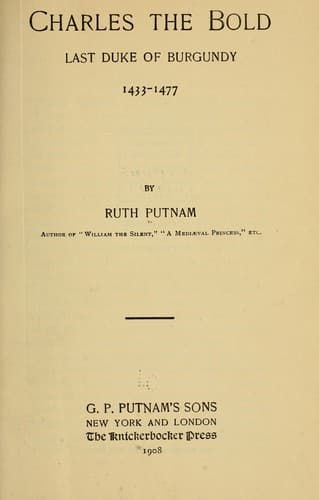
Charles the Bold, Last Duke of Burgundy, 1433-1477Putnam, Ruth
History
Charles the Bold, Last Duke of Burgundy, 1433-1477
Putnam, Ruth
Burgundy (France) -- History; Charles, Duke of Burgundy, 1433-1477; Switzerland -- History -- 1032-1499
worth no more than the king's, and words were assuredly at a discount
just then. A perusal of the international correspondence of the period
leaves the reader marvelling why time was wasted in covering paper,
with flimsy, insincere phrases, mendacious sign-posts which gave no
true indication of the road to be travelled. There are, however,
differences in the art of dissimulation and Charles never attained a
mastery of the science.
The adjective which has attached itself to his name in English in an
inaccurate rendering of _le téméraire_ which belongs to him in French.
There were other terms too applied to Charles at different periods of
his career. He was Charles the Hardy in his early youth, Charles the
Terrible in those last months when he tried to fortify himself with
wine unsuited to his constitution, but at all times he might have been
called Charles the self-absorbed, Charles the solitary. There have
been many men more passionate, more uncontrolled, than Charles of
Burgundy, whose personal magnetism yet enabled them to win friends and
to keep them, as the duke was powerless to do. The failure to command
personal devotion, unquestioning loyalty, was one of his chief
personal misfortunes. Philip, magnificent, lavish, debonair, found
many lenient apologists for his crimes, while his son received
criticism for his faults even from the faithful among his servitors.
How a reflection of his bearing glows out from the mirror turned
casually upon him by Commines' skilful hand! Take the glimpse of Louis
XI. as he lures on St. Pol's messenger to imitate Charles. The Sire
de Créville inspired by the royal interest in his narration about an
incident at the court of Burgundy, puffs out his cheeks, stamps his
feet in a dictatorial manner, and swears by St. George as he quotes
the duke's words. Behind a screen are hidden Commines, and a
Burgundian envoy aghast at hearing his liege lord so mocked. It is
a time when St. Pol is trying to ride three horses at once and
the French king takes this method to have Charles informed of his
duplicity. "Speak louder" he says, "I grow a little deaf," and the
flattered envoy repeats his dramatic performance in a way to engrave
it on the memory of the duke's retainer.
[Illustration: THE TOMB OF CHARLES OF BURGUNDY]
In thus touching on the traits of his former master, Commines does not
show malice or even a dislike for the duke. He is much more severe
about Louis--only he found the latter easier to serve.
In his family life, too, Charles does not seem to have found any
companionship that affected his life. He is lauded as a faithful
husband to Isabella of Bourbon but her death seemed to make little
difference. Neither she nor Margaret of York had the actual
significance enjoyed by Isabella of Portugal as consort to Philip the
Good with his notoriously roving fancy.
Public-domain text, read in full here on John Shaqi.
Reviews
Reviews
No reviews yet
Be the first to share your thoughts on this work.
Elsewhere in the archive
Join the Discussion
Join the discussion
Sign in to leave a comment or review.
Sign InorCreate an account