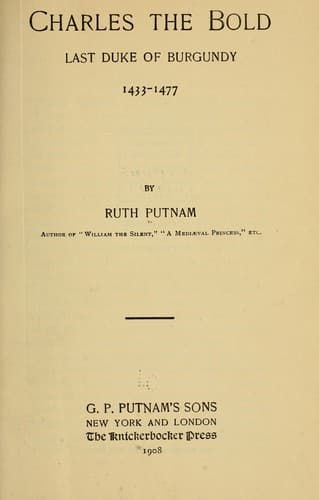
Charles the Bold, Last Duke of Burgundy, 1433-1477Putnam, Ruth
History
Charles the Bold, Last Duke of Burgundy, 1433-1477
Putnam, Ruth
Burgundy (France) -- History; Charles, Duke of Burgundy, 1433-1477; Switzerland -- History -- 1032-1499
The gala-day opened with a tournament at which Adolph of Cleves again
sported as Knight of the Swan to the applause of the onlookers. After
the jousting, the guests adjourned to the banqueting hall, where fancy
had indeed, run riot, to make ready for their admiring eyes and their
sagacious palates. _Entremets_ is the term applied to the elaborate
set pieces and side-shows provided to entertain the feasters between
courses, and these were on an unprecedented scale.
Three tables stood prepared respectively for the duke and his suite,
for the Count of Charolais, his cousins, and their comrades, and for
the knights and ladies. The first table was decorated with marvellous
constructions, among which was a cruciform church whose mimic clock
tower was capacious enough to hold a whole chorus of singers. The
enormous pie in which twenty-eight musicians were discovered when the
crust was cut may have been the original of that pasty whose opening
revealed four-and-twenty blackbirds in a similar plight. Wild animals
wandered gravely at a machinist's will through deep forests, but in
the midst of the counterfeit brutes there was at least one live lion,
for Gilles le Cat[5] received twenty shillings from the duke for the
chain and locks he made to hold the savage beast fast "on the day of
the said banquet."
Again there was an anchored ship, manned with a full crew and rigged
completely. "I hardly think," observes La Marche, "that the greatest
ship in the world has a greater number of ropes and sails."
Before the guests seated themselves they wandered around the hall
and inspected the decorations one by one. Nor was their admiration
exhausted when they turned to the discussion of the toothsome dainties
provided for their delectation.
During the progress of the banquet, the story of Jason was enacted.
Time there certainly was for the play. La Marche estimated forty-eight
dishes to every course, though he qualifies his statement by the
admission that his memory might be inexact. These dishes were wheeled
over the tables in little chariots before each person in turn.
"Such were the mundane marvels that graced the fête," is the
conclusion of La Marche's[6] exhaustive enumeration of the
masterpieces from artists' workshops and ducal kitchen.
"I will leave them now to record a pity moving _entremets_ which
seemed to be more special than the others. Through the portal
whence the previous actors had made their entrance, came a giant
larger without artifice than any I had ever seen, clad in a long
green silk robe, a turban on his head like a Saracen in Granada.
His left hand held a great, old-fashioned two-bladed axe, his
right hand led an elephant covered with silk. On its back was a
castle wherein sat a lady looking like a nun, wearing a mantle of
black cloth and a white head-dress like a recluse.[7]
Public-domain text, read in full here on John Shaqi.
Reviews
Reviews
No reviews yet
Be the first to share your thoughts on this work.
Join the Discussion
Join the discussion
Sign in to leave a comment or review.
Sign InorCreate an account