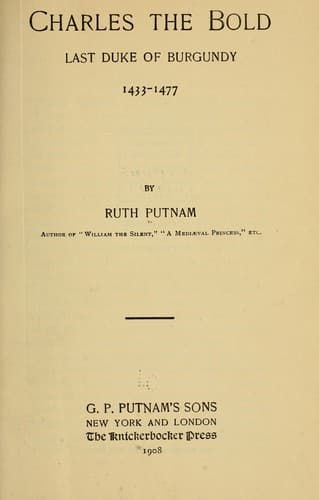
Charles the Bold, Last Duke of Burgundy, 1433-1477 — John Shaqi
Charles the Bold, Last Duke of Burgundy, 1433-1477Putnam, Ruth
History
Charles the Bold, Last Duke of Burgundy, 1433-1477
Putnam, Ruth
Burgundy (France) -- History; Charles, Duke of Burgundy, 1433-1477; Switzerland -- History -- 1032-1499
"When I had seen this _entremets_, that is, the Church and a
castle on the back of such a strange beast, I pondered as to
whether I could understand what it meant and could not make it out
otherwise except that she had brought this beast, rare among us,
in sign that she toiled and laboured in great adversity in the
region of Constantinople, whose trials we know, and the castle in
which she was signified Faith. Moreover, because this lady was
conducted by this mighty giant, armed, I inferred that she wished
to denote her dread of the Turkish arms which had chased her away
and sought her destruction.
"As soon as this play was played out, the noble gentlemen, moved
by pity and compassion, hastened to make vows, each in his own
fashion."
The vow of the Count of Charolais was as follows: "I swear to God
my creator, and to His glorious mother, to the ladies and to the
pheasant, that, if my very redoubtable lord and father embark on
this holy journey, and if it be his pleasure that I accompany him,
I will go and will serve him as well as I can and know how to do."
Other vows were less simple: all kinds of fantastic conditions being
appended according to individual fancy. One gentleman decided never to
go to bed on a Saturday until his pledge were accomplished. Another
that he would eat nothing on Fridays that had ever lived until he
had had an opportunity of meeting the enemy hand to hand, and of
attacking, at peril of his life, the banner of the Grand Turk.
Philip Pot vowed never to sit at table on a Tuesday and to wear no
protection on his right arm. This last the duke refused to permit.
Hugues de Longueval vowed that when he had once turned his face to the
East he would abstain from wine until he had plunged his sword in an
infidel's blood, and that he would devote two years to the crusade
even if he had to remain all alone, provided Constantinople were not
recovered. Louis de Chevelast swore that no covering should protect
his head until he had come to within four leagues of the infidels,
and that he would fight a Turk on foot with nothing on his arm but a
glove. There was the same emulation in the vows as in the banquets and
many of the self-imposed penalties were as bizarre as the side-shows.
There were so many chevaliers eager to bind themselves to the
enterprise that the prolonged ceremony threatened to become tedious.
The duke, therefore, declared that the morrow would be equally valid
as the day.[8]
The Count of St. Pol was the only knight present who made his going
dependent on the consent of the King of France, a condition very
displeasing to his liege lord of Burgundy.]
Public-domain text, read in full here on John Shaqi.
Reviews
Reviews
No reviews yet
Be the first to share your thoughts on this work.
Join the Discussion
Join the discussion
Sign in to leave a comment or review.
Sign InorCreate an account