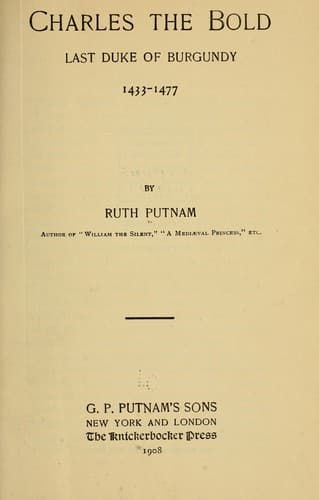
Charles the Bold, Last Duke of Burgundy, 1433-1477Putnam, Ruth
History
Charles the Bold, Last Duke of Burgundy, 1433-1477
Putnam, Ruth
Burgundy (France) -- History; Charles, Duke of Burgundy, 1433-1477; Switzerland -- History -- 1032-1499
This pledge of absolute fidelity to Dame Isabella was, indeed, utterly
disregarded by the bridegroom, but in outward and formal honour to her
he never failed.
The new institution was, from the beginning, pre-eminently significant
of the duke's magnificent state existence, wherein his Portuguese
consort proved herself an efficient and able helpmeet. Again and again
during a period of thirty years, rich in diplomatic parleying, did
Isabella act as confidential ambassador for her husband, and many were
the negotiations conducted by her to his satisfaction.[5]
But it must be noted that whatever lay at the exact root of Philip's
motives when he conceived the plan of his Order, the actual result of
his foundation was not affected. He failed, indeed, to bring back into
the world the ancient system of knighthood in its ideal purity and
strength. Rather did he make a notable contribution to its decadence
and speed its parting. What was brought into existence was a house
of peers for the head of the Burgundian family, a body of faithful
satellites who did not hamper their chief overmuch with the criticism
permitted by the rules of their society, while their own glory added
shining rays to the brilliant centre of the Burgundian court.
Twenty-five, inclusive of the duke, was the original number appointed
to form the chosen circle of knights. This was speedily increased to
thirty-one, and a duty to be performed in the session of 1433, was
the election of new members to fill vacancies and to round out the
allotted tale.
[Illustration: PHILIP THE GOOD AS FOUNDER OF THE ORDER OF THE GOLDEN
FLEECE]
In their manner of accomplishing the appointed task, the new
chevaliers had, from the outset, evinced a readiness to cast their
votes to the satisfaction of their chief, even if his pleasure
directly conflicted with the regulations they had sworn to obey. No
candidate was to be eligible whose birth was not legitimate,[6] a
regulation quite ignored when the duke proposed the names of his sons
Cornelius and Anthony. For his obedient knights did not refuse to open
their ranks to these great bastards of Burgundy, who carried a bar
sinister proudly on their escutcheon. So, too, others of Philip's many
illegitimate descendants were not rejected when their father proposed
their names.
Again, it was plainly stipulated that the new member should have
proven himself a knight of renown. Yet, in this session of 1433, one
of the candidates proposed for election, though nominally a knight,
had assuredly had no time to show his mettle. The dignity was his only
because his spurs had been thrown right royally into his cradle before
his tiny hands had sufficient baby strength to grasp a rattle, and
before he was even old enough to use the pleasant gold to cut his
teeth upon.[7]
Among the eight elected at Dijon in 1433, was Charles of Burgundy,
Count of Charolais, son of the sovereign duke, born at Dijon on the
previous St. Martin's Eve, November 10th.[8]
Public-domain text, read in full here on John Shaqi.
Reviews
Reviews
No reviews yet
Be the first to share your thoughts on this work.
Join the Discussion
Join the discussion
Sign in to leave a comment or review.
Sign InorCreate an account