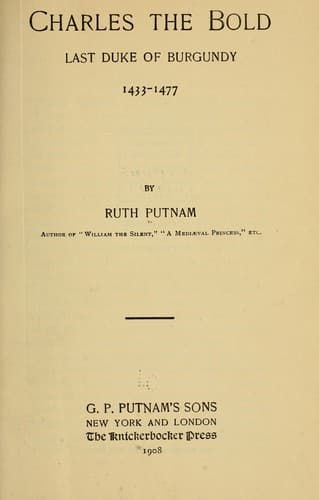
Charles the Bold, Last Duke of Burgundy, 1433-1477Putnam, Ruth
History
Charles the Bold, Last Duke of Burgundy, 1433-1477
Putnam, Ruth
Burgundy (France) -- History; Charles, Duke of Burgundy, 1433-1477; Switzerland -- History -- 1032-1499
Not long after Louis's coronation there occurred that change in
Philip's bodily constitution that comes to all active men sooner or
later. His health began to give way, his energies relaxed, and matters
that had been of paramount importance throughout his career were
allowed to slip into the background of his desires. In the famous
treaty of 1435, no article was rated at greater importance than that
which placed the towns on the Somme in Philip's hands, subject to a
redemption of two hundred thousand gold crowns. Whether Charles VII.
had actually pledged himself that the mortgage should hold at least
during Philip's life does not seem assured, but that any sum would be
insufficient to induce the duke to release them unless his intellect
were somewhat deadened, is clear.
In 1462, when he recovered from a sharp attack, possibly the result
of his indulgence in the pleasures of the table during the prolonged
festivities at Paris, he did not regain his previous vigour. This was
the time, by the way, when opportunity was afforded his courtiers to
prove that devotion to their seigneur outweighed personal vanity. When
his head was shaved by order of the court physician, more than five
hundred nobles sacrificed their own locks so that their becoming curls
might not remind their chief of his own bald head. The sacrifice was
not always voluntary, adds an informant.[1] Philip forced compliance
with this new fashion upon all who seemed reluctant to be
unnecessarily shorn of what beauty was theirs by nature's gift. This
servility may have consoled Philip for the deprivation of his hair. In
his depressed condition any solace was acceptable.
It was just when the duke was in this enfeebled state that Louis,
through the mediation of the Croys, pushed forward his proposition to
redeem the towns and Philip agreed, possibly relying upon the chance
that it would be no easy matter for the French king to wring the
required sum from his impoverished land. Philip's assent was, however,
promptly clinched by a cash payment of half the amount[2]; the
remainder followed.
Amiens, Abbeville, and the other towns, valuable bulwarks for the
Netherland provinces, fine nurseries for the human material requisite
for Burgundian armies, rich tax payers as they were, all tumbled into
the outstretched hands of the duke's wily rival.
Public-domain text, read in full here on John Shaqi.
Reviews
Reviews
No reviews yet
Be the first to share your thoughts on this work.
Elsewhere in the archive
Join the Discussion
Join the discussion
Sign in to leave a comment or review.
Sign InorCreate an account