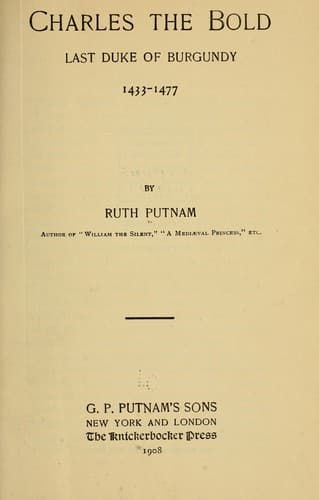
Charles the Bold, Last Duke of Burgundy, 1433-1477Putnam, Ruth
History
Charles the Bold, Last Duke of Burgundy, 1433-1477
Putnam, Ruth
Burgundy (France) -- History; Charles, Duke of Burgundy, 1433-1477; Switzerland -- History -- 1032-1499
The transaction was hurried through and completed before a rumour of
its progress came to the ear of the interested heir. Charles was in
Holland sulking and indignant. He had expected good results from his
tender devotion during his father's acute illness, a devotion shared
by Isabella of Portugal who hastened to her husband's bedside from her
convent seclusion when Philip was in need of her ministrations. But,
in his convalescence, Philip renewed his friendship for the Croys
whom Charles continued to distrust with bitterness that varied in its
intensity, but which never vanished from his consciousness. The young
man felt misjudged, misused, and ever suspicious that personal danger
to himself lurked in the air of his father's court.
The various rumours of plots against his life may not all have been
baseless. At last, one of own cousins, the Count of Nevers, was
accused of having recourse to diabolic means of doing away with the
duke's legitimate heir.[2] Three little waxen images were found in his
house, and it was alleged that he practised various magic arts withal
in order to win the favour of the duke and of the French king, and
still worse to cause Charles to waste away with a mysterious sickness.
The accusations were sufficient to make Nevers resign all his offices
in his kinsman's court and retire, post-haste, to France. Had he been
wholly innocent he would have demanded trial at the hands of his peers
of the Golden Fleece as behooved one of the order. But he withdrew
undefended, and left his tattered reputation fluttering raggedly in
the breeze of gossip.
Charles stayed in Holland aloof from the ducal court until a fresh
incident drove him thither to give vent to his indignation. Only three
days had Philip de Commines been page to Duke Philip, then resident at
Lille, when an embassy headed by Morvilliers, Chancellor of France,
was given audience in the presence of the Burgundian court, including
the Count of Charolais. The future historian,[4] then nineteen years
old, was keenly alive to all that passed on that November fifth, 1464.
Morvilliers used very bitter terms in his assertion that Charles had
illegally stopped a little French ship of war and arrested a certain
bastard of Rubempré on the false charge that his errand in Holland,
where the incident occurred, was to seize and carry off Charles
himself. Moreover, one knight of Burgundy, Sir Olivier de La Marche
had caused this tale to be bruited everywhere,
"especially at Bruges whither strangers of all nations resort.
This had hurt Louis deeply, and he now demanded through his
chancellor that Duke Philip should send this same Sir Olivier de
La Marche prisoner to Paris, there to be punished as the case
required. Whereupon, Duke Philip answered that the said Sir
Olivier was steward of his house, born in the County of Burgundy
and in no respect subject to the Crown of France."
Public-domain text, read in full here on John Shaqi.
Reviews
Reviews
No reviews yet
Be the first to share your thoughts on this work.
Elsewhere in the archive
Join the Discussion
Join the discussion
Sign in to leave a comment or review.
Sign InorCreate an account