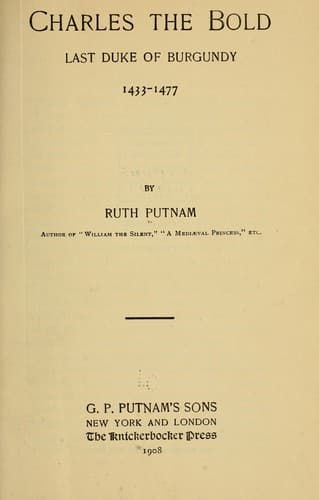
Charles the Bold, Last Duke of Burgundy, 1433-1477Putnam, Ruth
History
Charles the Bold, Last Duke of Burgundy, 1433-1477
Putnam, Ruth
Burgundy (France) -- History; Charles, Duke of Burgundy, 1433-1477; Switzerland -- History -- 1032-1499
Philip added that if his servant had wrought ill to the king's honour
he, the duke, would see to his punishment. As to the bastard of
Rubempré, true it was that he had been apprehended in Holland,[5] but
there was adequate ground for his arrest as his behaviour had been
strange, at least so thought the Count of Charolais. Philip added that
if his son were suspicious
"he took it not of him for he was never so, but of his mother
who had been the most jealous lady that ever lived. But
notwithstanding" [quoth he] "that myself never were supicious, yet
if I had been in my son's place at the same time that this bastard
of Rubempré haunted those coasts I would surely have caused him to
be apprehended as my son did."
In conclusion, Philip promised to deliver up Rubempré to the king were
his innocence satisfactorily proven.
Morvilliers then resumed his discourse, enlarging upon the treacherous
designs of Francis, Duke of Brittany, with whom Charles had lately
sworn brotherhood at the very moment when he was the honoured guest
of King Louis at Tours. During this discussion the Count of Charolais
became very restive. Finally he could no longer endure Morvilliers's
indirect slurs, and
"made offer eftsoon to answer, being marvellously out of patience
to hear such reproachful speeches used of his friend and
confederate. But Morvilliers cut him off, saying: 'My Lord of
Charolais, I am not come of ambassage to you, but to my Lord your
father.' The said earl besought his father divers times to give
him leave to answer, who in the end said unto him: 'I have
answered for thee as methinketh the father should answer for the
son, notwithstanding if thou have so great desire to speak bethink
thyself to-day and to-morrow speak and spare not.'"
Then Morvilliers to his former speech added that he could not imagine
what had moved the earl to enter into the league with the Duke of
Brittany unless it were because of a pension the king had once given
him together with the government of Normandy and afterwards taken from
him.
In regard to Rubempré, Commines adds to his story Charles's own
statement given on the morrow:
"Notwithstanding, I think nothing was ever proved against him, though
I confess the presumption to have been great. Five years after I
myself saw him delivered out of prison." This from Commines. La Marche
is less detailed in his record[6] of the Rubempré incident:
Public-domain text, read in full here on John Shaqi.
Reviews
Reviews
No reviews yet
Be the first to share your thoughts on this work.
Elsewhere in the archive
Join the Discussion
Join the discussion
Sign in to leave a comment or review.
Sign InorCreate an account