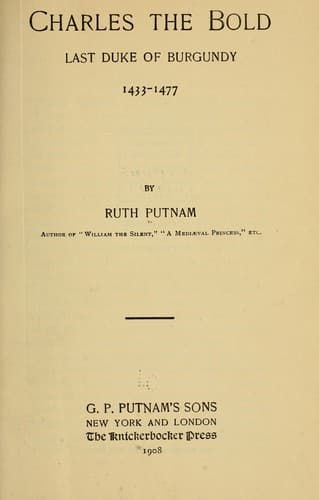
Charles the Bold, Last Duke of Burgundy, 1433-1477Putnam, Ruth
History
Charles the Bold, Last Duke of Burgundy, 1433-1477
Putnam, Ruth
Burgundy (France) -- History; Charles, Duke of Burgundy, 1433-1477; Switzerland -- History -- 1032-1499
[Footnote 13: I., ch. xii.]
[Footnote 14: Commines, I., ch. xii.]
[Footnote 15: La Marche, iii., p. 27.]
CHAPTER VII
LIEGE AND ITS FATE
1465-1467
"When we have finished here we shall make a fine beginning against
those villains the Liegeois." Thus wrote the count's secretary on
October 18th.[1] Charles had no desire to rest on the laurels won
before Paris. To another city he now turned his attention, to Liege
which owed nothing whatsoever to Burgundy.
Before the days when the buried treasures of the soil filled the
air with smoke, the valley where Liege lies was a lovely spot.[2]
Tradition tells how, in the sixth century, Monulphe, Bishop of
Tongres, as he made a progress through his diocese was attracted by
the beauties of the site where a few hovels then clustered near the
Meuse. After looking down from the heights to the river's banks for
a brief space, the bishop turned to his followers and said, as if
uttering a prophecy:
"Here is a place created by God for the salvation of many faithful
souls. One day a prosperous city shall flourish here. Here I will
build a chapel." Dedicated to Cosmo and Damian, the promised chapel
became a shrine which attracted many pilgrims who returned to their
various homes with glowing tales of the beautiful and fertile valley.
Little by little others came who did not leave, and by the seventh
century when Bishop Lambert sat in the see of Tongres, Liege was a
small town.
An active and loving shepherd was this Lambert. He gave himself no
rest but travelled continually from one church to another in his
diocese to look after the needs of his flock. He was a fearless
prelate, too, and his words of well-deserved rebuke to the Frankish
Pepin for a lawless deed excited the wrath of a certain noble,
accessory to the act. Trouble ensued and Lambert was slain as he knelt
before the altar in Monulphe's chapel at Liege. Absorbed in prayer
the pious man did not hear the servants' calls, "Holy Lambert, Holy
Lambert come to our aid," words that later became a war-cry when the
bishop was exalted into the patron saint of the town.
Not until the thirteenth century, however, when the episcopal see was
finally established at Liege, was Lambert's successor virtual lay
overlord of the region as well as Bishop of Liege. Monulphe's little
chapel had given way to a mighty church dedicated to the canonised
Bishop Lambert. The ecclesiastical state became almost autonomous, the
episcopal authority being restricted without the walls only by the
distant emperor and still more distant pope. Within the walls, the
same authority had by no means a perfectly free hand. There were
certain features in the constitution of Liege which differentiated it
from its sister towns in the Netherlands.
Public-domain text, read in full here on John Shaqi.
Reviews
Reviews
No reviews yet
Be the first to share your thoughts on this work.
Elsewhere in the archive
Join the Discussion
Join the discussion
Sign in to leave a comment or review.
Sign InorCreate an account