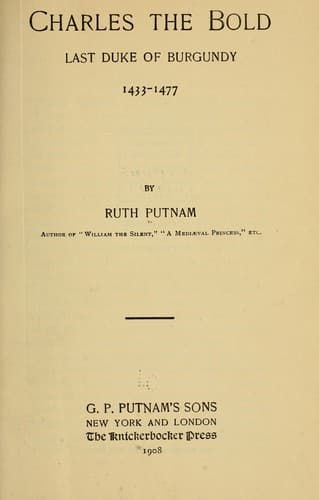
Charles the Bold, Last Duke of Burgundy, 1433-1477Putnam, Ruth
History
Charles the Bold, Last Duke of Burgundy, 1433-1477
Putnam, Ruth
Burgundy (France) -- History; Charles, Duke of Burgundy, 1433-1477; Switzerland -- History -- 1032-1499
Municipal affairs were conducted in a singularly democratic manner.
There was no distinction between the greater and lesser gilds, and,
within these organisations, the franchise was given to the most
ignorant apprentice had he only fulfilled the simple condition of
attaining his fifteenth year. Moreover, the naturalisation laws were
very easy. Newcomers were speedily transformed into citizens and
enjoyed eligibility to office as well as the franchise. The tenure of
office being for one year only, there was opportunity for frequent
participation in public affairs, an opportunity not neglected by the
community.[2]
The bishop was, of course, not one of the civic officers chosen by
this liberal franchise. He was elected by the chapter of St. Lambert,
subject to papal and imperial ratification for the two spheres of his
jurisdiction. But in the exercise of his function there were many
restrictions to his free administration, which papal and imperial
sanction together were unable to remove.
A bishop-prince of Liege could make no change in the laws without the
consent of the estates, and he could administer justice only by means
of the regular tribunals. Every edict had to be countersigned. When
there was an issue between overlord and people, the question was
submitted to the _schepens_ or superior judges who, before they gave
their opinion, consulted the various charters which had been granted
from time to time, and which were not allowed to become dead letters.
A permanent committee of the three orders supervised the executive and
the administration of the laws. These "twenty-two" received an appeal
from the meanest citizen, and the Liege proverb "In his own home the
poor man is king," was very near the possible truth.
Yet the wheels of government were by no means perfect in their
running. Many were the conflicts between the different members of the
state, and broils, with the character of civil war in miniature, were
of frequent occurrence. The submergence of the aristocratic element,
the nobles, destroyed a natural balance of power between the
bishop-prince and the people. The commons exerted power beyond their
intelligence. Annual elections, party contests headed by rival
demagogues kept the capital, and, to a lesser extent, the smaller
towns of the little state in continuous commotion[4].
The ecclesiastical origin of the community was evident at all points
of daily life. The cathedral of St. Lambert was the pride of the city.
Its chapter, consisting of sixty canons, took the place held by the
aristocratic element in the other towns.
In the cathedral, the holy standard of St. Lambert was suspended. At
the outbreak of war this was taken down and carried to the door by the
clergy in solemn procession. There it was unfurled and delivered to
the commander of the civic militia mounted on a snow-white steed. When
he received the precious charge he swore to defend it with his life.
Public-domain text, read in full here on John Shaqi.
Reviews
Reviews
No reviews yet
Be the first to share your thoughts on this work.
Elsewhere in the archive
Join the Discussion
Join the discussion
Sign in to leave a comment or review.
Sign InorCreate an account