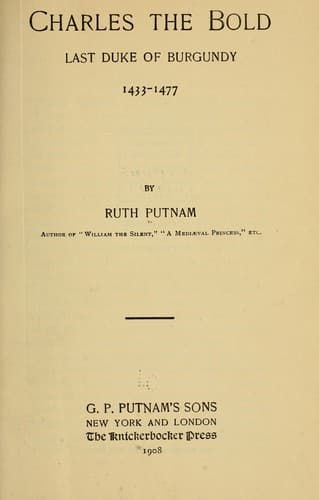
Charles the Bold, Last Duke of Burgundy, 1433-1477Putnam, Ruth
History
Charles the Bold, Last Duke of Burgundy, 1433-1477
Putnam, Ruth
Burgundy (France) -- History; Charles, Duke of Burgundy, 1433-1477; Switzerland -- History -- 1032-1499
His audience with the envoys resulted in a treaty, of which certain
articles were so harsh that the messengers were insulted when the
report was made in Liege. Only eleven out of thirty-two gilds voted to
accept all the articles. A certain noble on pleasant terms with the
count offered to carry the unpopular document back to him to ask for a
modification of the harsh terms.
By this time the weather was severe. Charles's troops were in need of
repose, and it seemed prudent to avoid hostility if possible. Charles
revoked the objectionable clauses in consideration of an increase of
the war indemnity. With this change the treaty was accepted, and a
Piteous Peace it was indeed for the proud folk of Liege. Instead
of owing allegiance to emperor and to pope alone as free imperial
citizens, they agreed to recognise the Burgundian dukes as hereditary
protectors of Liege.
When it was desired, Burgundian troops could march freely across the
territory. Burgundian coins were declared valid at Burgundian values.
No Liege fortresses were to menace Burgundian marches, and unqualified
obedience was pledged to the new overlords. The same terms were
conceded to all the rebel towns alike except to Dinant. The story of
the personal insult to himself and his mother had reached the count's
ears and he was not inclined to ignore the circumstance. His further
action was, however, deferred.
January 24, 1466, is the final date of the treaty[11] and, after its
conclusion, Charles ordered a review of his forces, a review that
almost culminated in a pitched battle between army and citizens of St.
Trond, and then on January 31st, the count returned to Brussels where
there was a great display of Burgundian etiquette before the duke
embraced his victorious son.
Piteous as was the peace for Liege and the province at large, still
more piteous was the lot of Dinant which alone was excluded from the
participation in the treaty. Her fate remained uncertain for months.
Other affairs occupied the Count of Charolais until late in the summer
of 1466. Time had quickly proven that Louis, well freed from the
allies pressing up to the gates of Paris, was in very different temper
from Louis ill at ease under their strenuous demands. Not only had
he withdrawn his promises in regard to the duchy conferred on his
brother, but he had begun taking other measures, ostensibly to prepare
against a possible English invasion, which alarmed his cousin of
Burgundy for the undisturbed possession of his recently recovered
towns on the Somme.
Excited by the rumours of Louis's purposes, Charles despatched the
following letter from Namur:[12]
"MONSEIGNEUR:
Public-domain text, read in full here on John Shaqi.
Reviews
Reviews
No reviews yet
Be the first to share your thoughts on this work.
Elsewhere in the archive
Join the Discussion
Join the discussion
Sign in to leave a comment or review.
Sign InorCreate an account