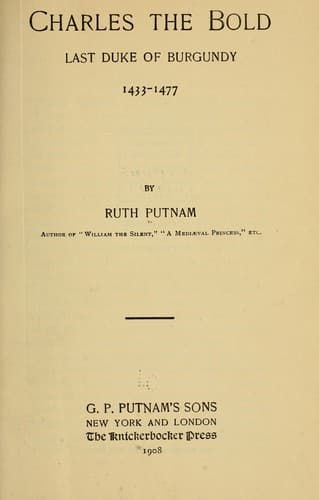
Charles the Bold, Last Duke of Burgundy, 1433-1477Putnam, Ruth
History
Charles the Bold, Last Duke of Burgundy, 1433-1477
Putnam, Ruth
Burgundy (France) -- History; Charles, Duke of Burgundy, 1433-1477; Switzerland -- History -- 1032-1499
"I recommend myself very humbly to your good grace and beg to
inform you, Monseigneur, that recently I have been advised of
something very surprising to me, Moreover, I am now put beyond
doubt considering the source of my information. It is with much
regret that I communicate it to you when I remember all the good
words you have given to me this year, orally and in writing.
Monseigneur, it is evident that there has been some agreement
between your people and the English, and that the matter has been
so well worked that you have consented, as I have heard, to yield
them the land of Caux, Rouen, and the connecting villages, and to
aid them in withholding Abbeville and the county of Ponthieu, and
further, to cement with them certain alliances against me and my
country in making them large offers greatly to my prejudice and,
in order to complete the whole, they are to come to Dieppe.
"Monseigneur, you may dispose of your own as you wish: but,
Monseigneur, in regard to what concerns me, it seems to me that
you would do better to leave my property in my hand than to be the
instrument of putting it into the hands of the English or of any
foreign nation. For this reason I entreat you, Monseigneur, that
if such overtures or greater ones have been opened by your people
that you will not commit yourself to them in any manner but will
insist on their cessation, and that you will do this in a way that
I may always have cause to remain your very humble servant as I
desire to do with all my heart. Above all, write to me your good
pleasure, and I implore you, Monseigneur, if there be any service
that I can render you, I am the one who would wish to employ all
that God has given me [to do it]. Written at Namur, August 16th.
"Your very humble and obedient subject,
"CHARLES."
Then the count proceeded to Dinant to inflict the punishment that the
culprits had, to his mind, too long escaped.
Commines calls this a strong and rich town, superior even to
Liege.[13] A comparison of the two sites shows, however, that this
statement could hardly have been true at any time. Dinant lies in a
narrow space between the Meuse and high land. A lofty rock at one
end of the town dominating the river is crowned by a fortress most
picturesque in appearance. It is difficult to estimate how many
inhabitants there actually were in the place in 1466, but there is
no doubt as to their energy and character. As mentioned before, the
artisans had acquired a high degree of skill in their specialty, and
their brass work was renowned far and wide. Pots and pans and other
utensils were known as _Dinanderies_.
Public-domain text, read in full here on John Shaqi.
Reviews
Reviews
No reviews yet
Be the first to share your thoughts on this work.
Elsewhere in the archive
Join the Discussion
Join the discussion
Sign in to leave a comment or review.
Sign InorCreate an account