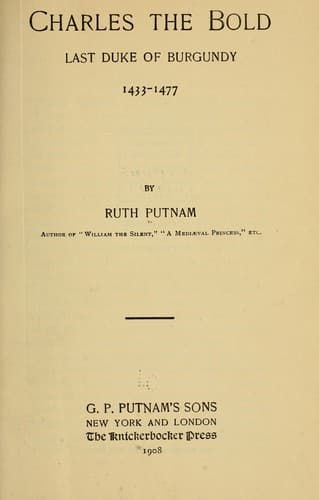
Charles the Bold, Last Duke of Burgundy, 1433-1477Putnam, Ruth
History
Charles the Bold, Last Duke of Burgundy, 1433-1477
Putnam, Ruth
Burgundy (France) -- History; Charles, Duke of Burgundy, 1433-1477; Switzerland -- History -- 1032-1499
During that summer the critical position of the little town was well
known. Some sympathisers offered aid but it was aid that there was
possible danger in accepting. Many of the outlaws from Liege, who had
been expressly excluded from the terms of the peace, had joined the
ranks of a certain free lance company called "The Companions of the
Green Tent," as their only shelter was the interlaced branches of the
forest. To Dinant came this band to aid in her defence.[18] At one
time it seemed as though a peaceful accommodation might be reached but
it fell through. Not yet were the citizens ready to surrender their
charters--"Franchises,--to the rescue," was a frequent cry and no
treaty was made.
Philip, long inactive, resolved to assist at the reduction of this
place in person. Too feeble to ride, he was carried to the Meuse in a
litter, and arrived at Namur on August 14th. Then attended by a small
escort only, he proceeded to Bouvignes, a splendid vantage point
whence he could command a view of the scene of his son's intended
operations. As the crisis became imminent there were a few further
efforts to effect a reconciliation. When these failed, the town
prepared to meet the worst.[19] Stories gravely related by Du
Clercq[20] represent the people of Dinant goaded to actual fury of
resistance.
By August 7th, the Burgundian troops made their appearance, winding
down to the river. Conspicuous among the standards--and nobles from
all Philip's dominions were in evidence--was the banner of the Count
of Charolais, displaying St. George slaying the dragon.
On Tuesday, August 19th, Dinant was invested and the siege began.
Within the walls the most turbulent element had gained complete
control of affairs. All thought of prudence was thrown to the winds.
From the walls they hurled words at the foe:
"Is your old doll of a duke tired of life that you have brought him
here to perish?[21] Your Count Charlotel is a green sprout. Bid him
go fight the King of France at Montl'hêry. If he waits for the noble
Louis or the Liegeois he will have to take to his heels," etc.
It was a heavy siege and the town was riddled with cannon-balls but
there was no assault. By the sixth day the magistrates determined
to send their keys to the Count of Charolais and beg for mercy. The
captain of the great gild of coppersmiths, Jean de Guérin, tried to
encourage the faint-hearted to protest openly against this procedure.
Seizing the city colours he declared: "I will trust to no humane
sentiment. I am ready to carry this flag to the breach and to live or
die with you. If you surrender, I will quit the town before the foe
enter it." It was too late, the capitulation was made.
When the keys were brought to Charles he remembered that he was not
yet duke and ordered them presented to his father in his stead, and to
his half-brother Anthony was entrusted the task of formally accepting
the surrender.
Public-domain text, read in full here on John Shaqi.
Reviews
Reviews
No reviews yet
Be the first to share your thoughts on this work.
Elsewhere in the archive
Join the Discussion
Join the discussion
Sign in to leave a comment or review.
Sign InorCreate an account