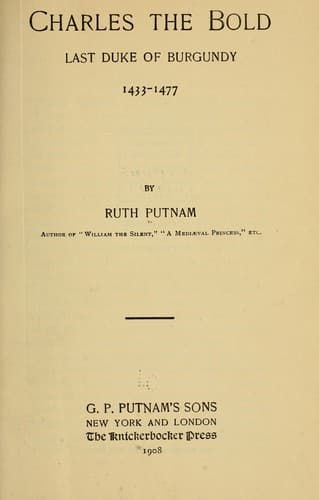
Charles the Bold, Last Duke of Burgundy, 1433-1477Putnam, Ruth
History
Charles the Bold, Last Duke of Burgundy, 1433-1477
Putnam, Ruth
Burgundy (France) -- History; Charles, Duke of Burgundy, 1433-1477; Switzerland -- History -- 1032-1499
It was late in the evening when the Bastard of Burgundy marched in. At
first he held the incoming troops well under control, but the stores
of wine were easy to reach, and by the morning there were wild scenes
of disorder. When Charles arrived, however, on the morrow, Tuesday,
just a week after the beginning of the siege, lawlessness was checked
with a strong hand. Any ill treatment of women was peculiarly
repugnant to him, and he did not hesitate to execute the sternest
justice upon offenders.[22]
[Illustration: ANTHONY OF BURGUNDY AFTER HANS MEMLING. DRESDEN
GALLERY]
His entry into the fallen town was made with all the wonted Burgundian
pomp. Nothing in the proceedings occurred in a headlong or passionate
manner. A council of war was held and the proceedings decided upon.
The cruelty that was exercised was used in deliberate punishment,
not in savage lawlessness. The personal insults to his mother and to
himself rankled in the count's mind. As one author remarks[23] with
undoubted reason, it is not likely that any of those responsible for
the insult were among those punished. After the siege, "pitiable it
was to see, for the innocent suffered and the guilty escaped."
Certain rich citizens bought their lives with large sums, others _were
sold as slaves,_[24] or were hanged or beheaded, or were thrown into
the Meuse.[25] In the monasteries, life was conceded to the inmates
but that was all. All their property was confiscated. The Count of St.
Pol, now Constable of France, tried to intercede for the citizens with
Philip who remained at Bouvignes, but to no result. It might have been
chance or it might have been intentional that at last flames completed
the work of destruction. The abode of Adolph of Cleves, at the corner
of Nôtre Dame, was found to be on fire at about one o'clock in the
morning of Thursday, August 28th.
That Charles was responsible for this conflagration Du Clercq thinks
is incredible.[26] He would certainly have saved all ecclesiastical
property which was almost completely consumed. Indeed, Charles gave
orders to extinguish the flames as soon as they were discovered, but
every one was so occupied with saving his own portion of booty that
nothing was accomplished and the town-hall caught fire and the church
of Nôtre Dame. From the latter some ornaments and treasures were saved
and the bones of Ste. Perpète, with other holy relics, were rescued by
Charles himself at risk to his own life.
"It was never known how the fire originated. Some say it was
due to a defective flue. To my mind," [concludes the pious
historian],[27] "it was the Divine Will that Dinant should be
destroyed on account of the pride and ill deeds of the people. I
trust to God who knows all. The duke's people alone lost more than
a hundred thousand crowns' value."
_Cy fust Dinant_, "Dinant was," is the sum of his description, four
days after the conflagration.[28]
Public-domain text, read in full here on John Shaqi.
Reviews
Reviews
No reviews yet
Be the first to share your thoughts on this work.
Elsewhere in the archive
Join the Discussion
Join the discussion
Sign in to leave a comment or review.
Sign InorCreate an account