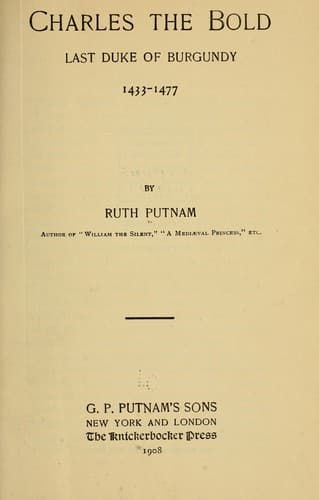
Charles the Bold, Last Duke of Burgundy, 1433-1477Putnam, Ruth
History
Charles the Bold, Last Duke of Burgundy, 1433-1477
Putnam, Ruth
Burgundy (France) -- History; Charles, Duke of Burgundy, 1433-1477; Switzerland -- History -- 1032-1499
See also _Doc. inédits concernant l'hist. de la Belgique_, ii., 238,
for comment on Scott's treatment of the language.]
[Footnote 7: The numbers are probably exaggerated. To-day it contains
about two hundred thousand.]
[Footnote 8: Du Clercq, iv., 203.]
[Footnote 9: Du Clercq, iv., 249.]
[Footnote 10: Du Clercq, iv., 239-262.]
[Footnote 11: Gachard, _Doc. inéd_., ii., 285, 322. For letters and
negotiations anterior to this peace see p. 197 _et seq_.]
[Footnote 12: Duclos, v., 236.]
[Footnote 13: Book ii., ch. i. To-day there are only about eight
thousand inhabitants.]
[Footnote 14: In addition to Commines and Du Clercq _see also_ Kirk,
i., 385, for quotations from Borgnet and others.]
[Footnote 15: Gachard, _Doc. inéd_., i., 213, _et passim_.]
[Footnote 16: Gachard, _Doc. inéd.,_ ii., 350.]
[Footnote 17: Est falme commune que tres haute princesse la ducesse
de Bourgogne, à cause desdictes injures at conclut telle hayne sur
cestedite ville de Dinant qu'elle a juré comme on dist que s'il li
devoit couster tout son vaellant, fera ruynner cestedite ville en
mettant toutes personnes à l'espée. (Gachard, _Doc. inéd_., ii.,
222.)]
[Footnote 18: Gachard, _Doc. inéd_., ii., 337, _et passim_.]
[Footnote 19: Du Clercq, iv., 273.]
[Footnote 20: He says messengers were put to death without regard to
their sacred office, even a little child being torn limb from limb.
Priests were thrown into the river for refusing to say mass, and the
situation was strained to the last degree.]
[Footnote 21: _Qui a mandé ce vieil monnart vostre duc_, etc.]
[Footnote 22: Du Clercq, iv., 278.]
[Footnote 23: De Ram, _Documents relatifs aux troubles du pays de
Liége,_ "Henricus de Merica," p. 159.]
[Footnote 24: Vel vendebantur in servos. See De Ram _et passim_ for
documents.]
[Footnote 25: It seems to be well attested that the prisoners were
tied together and drowned.]
[Footnote 26: Du Clercq, iv., 280.]
[Footnote 27: _Ibid._, 281.]
[Footnote 28: In 1472, a new church was erected "on the spot formerly
called Dinant" and after that, little by little, the town came to
life. (Gachard, _Analectes Belgiques_, 318, etc.).]
CHAPTER VIII
THE NEW DUKE
1467
The Good Duke's journey to Bouvignes where he witnessed the manner in
which his authority was vindicated was his last effort. In the early
summer following, on Friday, June 10th, Philip, then at Bruges, was
taken ill and died on the following Monday, June 13th, between nine
and ten in the evening.[1] Charles was summoned on the Sunday, and it
seemed as though his horse's hoofs hardly struck the pavement as he
rode, so swift was his course on the way to Bruges.
Public-domain text, read in full here on John Shaqi.
Reviews
Reviews
No reviews yet
Be the first to share your thoughts on this work.
Elsewhere in the archive
Join the Discussion
Join the discussion
Sign in to leave a comment or review.
Sign InorCreate an account