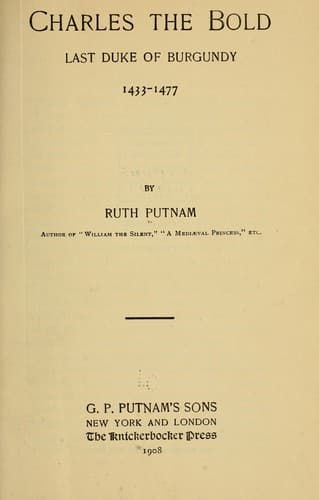
Charles the Bold, Last Duke of Burgundy, 1433-1477Putnam, Ruth
History
Charles the Bold, Last Duke of Burgundy, 1433-1477
Putnam, Ruth
Burgundy (France) -- History; Charles, Duke of Burgundy, 1433-1477; Switzerland -- History -- 1032-1499
On September 1st, Philip, who had remained at Bouvignes while all this
passed under the direction of Charles, took boat and sailed down to
Namur. It was almost a triumph,--that trip that proved one of the last
ever made by the proud duke--and the procession on the river and the
entry into Namur were closed by a humble embassy from Liege in regard
to certain points of their peace.
Du Clercq gravely relates, by the way, that the Count of St. Pol's men
had had no part in the plunder of Dinant. This was hard on the
poor fellows. Therefore, Philip turned over to their mercies, as a
compensation for this deprivation, the little town of Tuin, which had
been rebellious and then submitted. Tuin accepted its fate, submitted
to St. Pol, and then compounded the right of pillage for a round sum
of money. Moreover, they promised to lay low their gates and their
walls and those of St. Trond. In this way, it is said that the
constable made ten thousand Rhenish florins. Still both he and his men
felt ill-compensated for the loss of the booty of Dinant.
Charles continued a kind of harassing warfare on the various towns of
Liege territory. The people of Liege themselves seem to have varied
in their humour towards Charles, sometimes being very humble in their
petitions for peace and again very insolent. As a rule, this conduct
seems to be traceable to their hope of Louis's support. On September
7th, there was one pitched battle where victory decided the final
terms of the general peace, and after various skirmishes and
submissions, Charles disbanded his troops for the winter and joined
his father at Brussels.
[Footnote 1: _Doc. inédits sur l'hist. de France_. "Mélanges," ii.,
398.]
[Footnote 2: Polain, _Récits historiques sur l'ancien pays de Liège_,
I, etc.]
[Footnote 3: See Kirk, _Charles the Bold_, i., 329.]
[Footnote 4: Jacques de Hemricourt suggested four chief points of
difficulty in Liege government:
1. The size of the council--two hundred, where twenty would do.
2. The equal voice granted to all gilds without regard to size, when
all were assembled by the council to vote on a matter.
3. Extension of franchise to youths of fifteen.
4. Facile naturalisation laws. (_See_ Kirk, i., 325.)]
[Footnote 5: In many cases when the interdict was imposed, it is
probable that it was only partially operative.]
[Footnote 6: See Victor Hugo, _Le Rhin_, i. The Walloon dialect varies
greatly between the towns. Here are a few words of the "Prodigal Son"
as they are written in Liege, Huy, and Lille:
LIEGE. Jésus lizi d'ha co: In homme aveut deux fis. Li pus jone dérit
à s'père: père dinnez-m'con qui m'dent riv' ni di vosse bin; et l'père
lezi partagea s'bin.
HUY. Jésus l'zi d'ha co: Eun homme avut deux fis. Li peus jone dérit a
s'père etc.
LILLE. Jesus leu dit incore: un homme avot deux garchens. L'pus jeune
dit à sin père-mon père donez me ch que j'dor recouvre d'vo bien; et
l'père leu-z-a doné a chacun leu parchen.
Public-domain text, read in full here on John Shaqi.
Reviews
Reviews
No reviews yet
Be the first to share your thoughts on this work.
Elsewhere in the archive
Join the Discussion
Join the discussion
Sign in to leave a comment or review.
Sign InorCreate an account